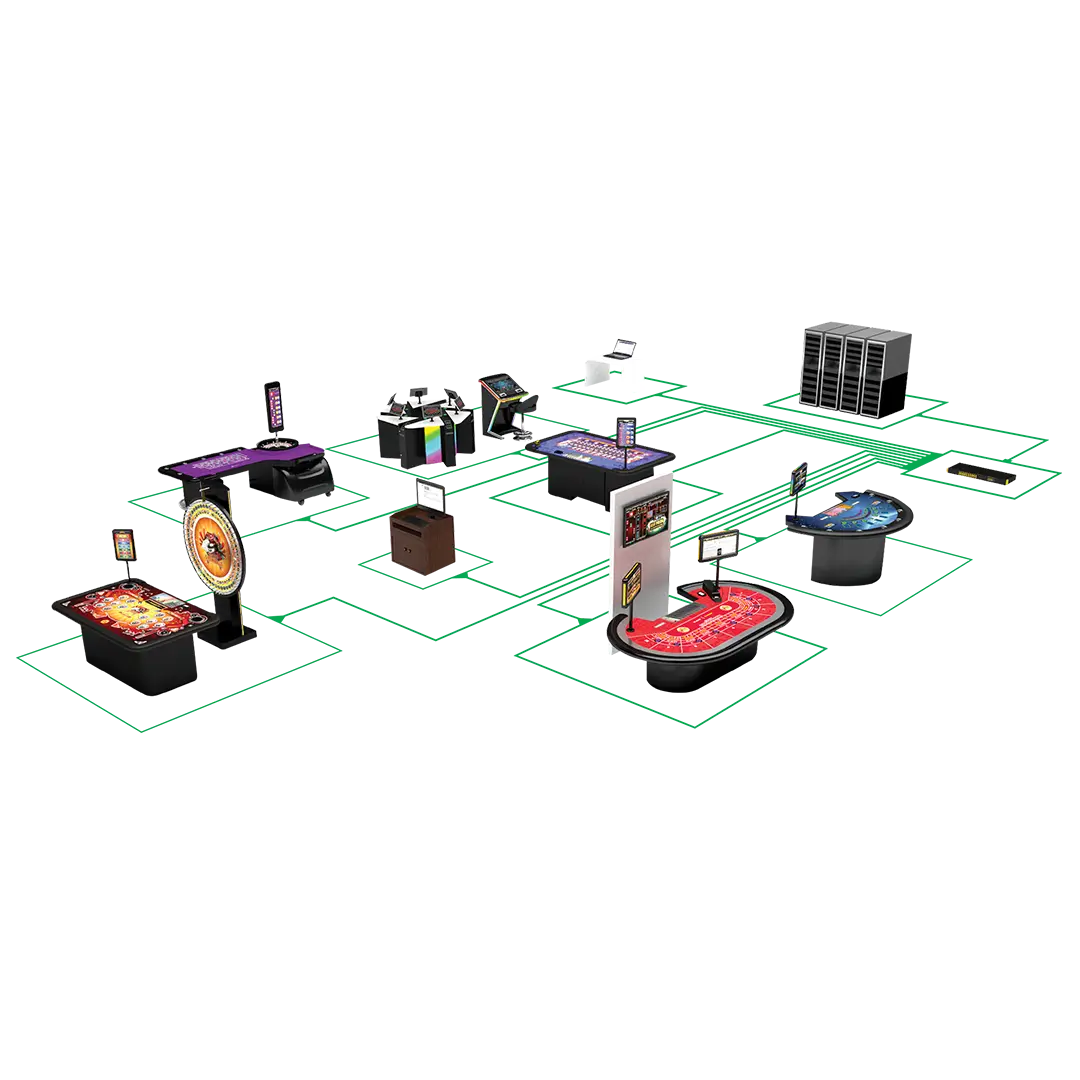

Technical Challenges
Data format inconsistency: Casino management systems typically use multiple data formats (SQL Server, Oracle, MySQL, etc.), while AI systems may use NoSQL or specific data formats, causing data conversion difficulties.
Varying data quality: Historical data may contain missing values, outliers, and format inconsistencies, affecting AI model training effectiveness.
High real-time requirements: Casino operations require second-level responses, but traditional ETL processing may cause data delays.
Solutions
Establish unified data standards: Develop data exchange specifications, adopt JSON/XML standard formats, and use data mapping tools for heterogeneous data conversion.
Implement data governance: Establish a data quality monitoring system and improve data quality through preprocessing processes such as data cleaning, deduplication, and completion.
Adopt streaming processing technology: Use streaming frameworks like Kafka and Flink for real-time data collection and processing to meet low-latency requirements.
Technical Challenges
High concurrent access pressure: Casino peak periods may generate massive concurrent requests, requiring AI systems to process large volumes of real-time data.
High computational resource demands: AI model training and inference require substantial computational resources, potentially impacting existing system performance.
Insufficient system scalability: Traditional monolithic architectures struggle with business growth, and system expansion costs are high.
Solutions
Microservices architecture transformation: Split the system into independent microservices to achieve service decoupling and elastic scaling.
Introduce containerization technology: Use Docker and Kubernetes for dynamic resource scheduling and automatic scaling.
Adopt cloud-native architecture: Deploy to cloud platforms, leveraging elastic computing capabilities of cloud services for on-demand resource allocation.
Technical Challenges
Sensitive data leakage risks: Casinos handle large amounts of customer private data (identity information, transaction records, etc.), posing data leakage risks during integration.
Strict compliance requirements: Need to comply with data protection regulations such as GDPR and CCPA, as well as special regulatory requirements of the casino industry.
Complex multi-system permission management: Different systems have different permission control mechanisms, increasing management complexity after integration.
Solutions
Implement end-to-end encryption: Encrypt data during transmission and storage using TLS/SSL protocols to ensure security.
Establish data masking mechanisms: Mask sensitive data while retaining only necessary information for AI analysis.
Unified permission management platform: Establish role-based access control (RBAC) for cross-system unified permission management.
Technical Challenges
Single point of failure risk: Critical component failures may cause entire system paralysis.
Complex service dependencies: Multiple systems depend on each other, where one service failure may trigger chain reactions.
Insufficient fault tolerance: Lack of automatic recovery mechanisms during system anomalies.
Solutions
Implement high-availability architecture: Adopt active-standby or clustered deployment modes to ensure service availability.
Introduce service circuit breaker mechanisms: Use circuit breakers such as Hystrix to prevent cascading failures.
Establish comprehensive monitoring systems: Use tools like Prometheus and Grafana for real-time monitoring and alerting.
Technical Challenges
Diverse technology stacks: Systems may use Java, Python, .NET, and other stacks, increasing integration difficulty.
Version compatibility issues: System upgrades may cause interface incompatibility, affecting business continuity.
High maintenance costs: Multi-system integration increases troubleshooting and maintenance workload.
Solutions
Adopt API gateway pattern: Manage all interfaces centrally to reduce integration complexity.
Develop version management specifications: Use semantic versioning to ensure backward compatibility.
Establish DevOps processes: Reduce maintenance costs through automated deployment and CI/CD pipelines.
Technical Challenges
Data stream processing latency: Millisecond-level delays from data ingestion to AI output may impact real-time decision-making.
Data consistency assurance: Ensuring data consistency and integrity in distributed environments.
Complex event processing: Need to identify complex business event patterns in real time.
Solutions
Adopt streaming-batch unified architecture: Use Spark Streaming or Flink for unified real-time and batch processing.
Implement distributed transactions: Use two-phase commit or eventual consistency schemes.
Introduce CEP engines: Use complex event processing engines such as Esper.
Technical Challenges
Complex model deployment: AI models require specific runtime environments, making production deployment challenging.
Difficult model version management: Multiple model versions coexist, complicating lifecycle management.
Online learning and updates: Achieving real-time model updates and online learning.
Solutions
Containerized deployment: Package models and dependencies into Docker images for one-click deployment.
Establish model management platforms: Use MLflow or Kubeflow to manage model versions and lifecycles.
Implement A/B testing: Validate new models through traffic splitting before full rollout.
Technical Challenges
High initial investment costs: Significant upfront investment in hardware, software, and manpower.
Ongoing maintenance costs: Continuous expenses for system maintenance and cloud services.
Long return on investment cycle: AI systems take time to demonstrate measurable results.
Solutions
Adopt cloud service pay-as-you-go models: Reduce initial investment pressure.
Phased implementation: Deploy core functions first, then expand gradually.
Establish KPI indicator systems: Regularly evaluate system performance and ROI.
Interested in our products? Click the button below to book a demo or get more information