Casino revenue leakage does not always appear as an obvious theft, counterfeit-chip incident or large accounting shortage. In many table-game operations, losses develop through small discrepancies that remain unresolved across individual rounds, dealer shifts and cage transactions.
A wager may be recorded at the wrong value. A game result may not match the settlement completed at the table. A promotional chip may be processed as a cash-value chip. A banker commission may be omitted. A damaged chip may be physically removed from circulation but remain active in the inventory database. A fill or credit may also be entered without a complete record of the chips transferred.
Each incident may appear insignificant when examined separately. The financial risk increases when the casino cannot identify where the discrepancy occurred or which authorized transaction should explain the change.
This is why RFID chip identification alone is not a complete revenue-control solution. RFID technology can give each chip a digital identity and collect information at configured reading points, but it does not independently determine whether the wager was valid, whether the game result was correct or whether the dealer collected and paid the right amount.
A complete casino management system must connect the physical movement of chips with the operating events that caused that movement. The purpose is not merely to know that a chip changed location. The purpose is to determine whether that change was expected, authorized and financially correct.
A casino table involves several departments and operating roles. Dealers manage cards, wagers and settlements. Floor supervisors monitor the game and approve selected transactions. Cage personnel issue, redeem and transfer chips. Finance and audit teams reconcile table inventories, fills, credits, commissions and reported gaming revenue.
A traditional control process can verify the opening and closing value of a table. However, a difference between those two totals does not automatically reveal where the error occurred.
Consider a baccarat table that opens with the correct inventory but closes the shift with a shortage. The final count confirms that a variance exists, but the count itself cannot explain whether it resulted from an incorrect payout, an uncollected losing wager, a missing commission, an undocumented chip transfer, a counting error or an authorized adjustment that was not recorded correctly.
Several recurring situations can gradually create these control gaps:
A higher-denomination chip may be placed in the wrong stack or betting zone and counted as a lower denomination.
A losing wager may not be fully collected before the next round begins.
A winning wager may be paid using the wrong ratio or paid twice during a busy operating period.
Chips may be transferred between the cage and a table without a complete matching fill or credit record.
A promotional or nonnegotiable chip may be handled under rules intended for cash-value chips.
A damaged chip may be withdrawn from play without being formally removed from active digital inventory.
A dealer, supervisor or cashier may complete the physical operation before the related system entry is created.
When these events are discovered only during an end-of-shift count, investigators may need to review paper records, terminal entries, employee explanations and several hours of surveillance footage. If the shortage accumulated across multiple rounds, identifying the original transaction becomes considerably more difficult.
A management system reduces this uncertainty by identifying the point at which the chip, wager, game and settlement records stopped agreeing.
Chip shrinkage generally refers to a reduction in expected chip inventory that cannot be explained by an authorized and documented transaction. However, not every chip outside its expected location represents an immediate financial loss.
A valid chip may remain in a player’s possession and be presented for redemption later. A chip may have been transferred to another controlled area but entered incorrectly in the system. A damaged chip may have been removed from the gaming floor but not formally retired from active inventory. Another chip may still be inside the property but placed in the wrong tray or denomination stack.
For management purposes, these conditions should be separated rather than combined into one general shortage figure.
An inventory variance exists when the physical or electronically detected chip total does not match the amount supported by authorized inventory records.
This may be caused by counting errors, unrecorded transfers, chips placed in the wrong tray, incomplete fills or credits, delayed system entries or unauthorized movement.
A settlement variance exists when the amount collected from or paid to a betting position does not agree with the wager, game result and configured payout rules.
For example, the chips may all remain accounted for physically, but an incorrect payout can still reduce table revenue.
A lifecycle variance occurs when the physical condition of a chip does not match its digital status.
A damaged chip that has been withdrawn from play but remains active in the system creates false inventory. A chip destroyed without an approved retirement record creates an unexplained inventory reduction.
A casino management system must distinguish these situations so that genuine losses, outstanding player-held chips, equipment problems and administrative errors are not treated as the same event.
RFID is a wireless identification system composed of tags and readers. A compatible reader emits radio waves and receives identity or other stored information from the tag. RFID technology is commonly used for inventory control, equipment tracking and automated data collection.
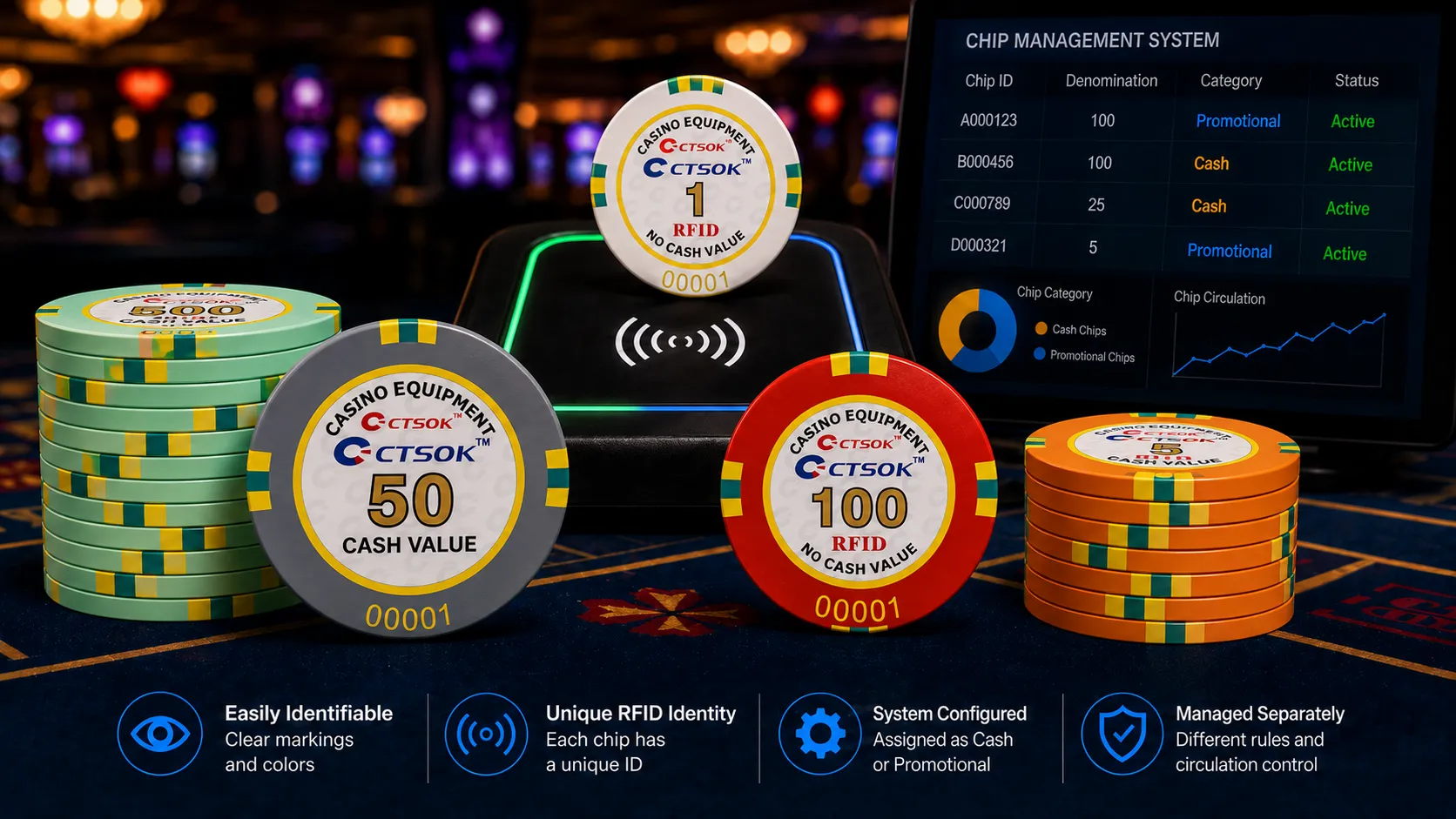
In a casino environment, an RFID-enabled chip can be associated with a unique identifier, denomination, chip category, activation status and operating permissions.
This allows the system to distinguish individual chips rather than recording only a total quantity of visually similar pieces.
However, RFID should not be described as a universal positioning system. A chip is detected only where compatible reading infrastructure has been installed and configured. Reader placement, antenna design, chip stacking, table construction, signal interference and detection-zone boundaries all affect the quality of the collected data.
The management platform therefore provides the operating context. It determines whether a detected chip is part of the dealer tray, a wager, a payout, a cage transfer, a redemption or an inventory adjustment.
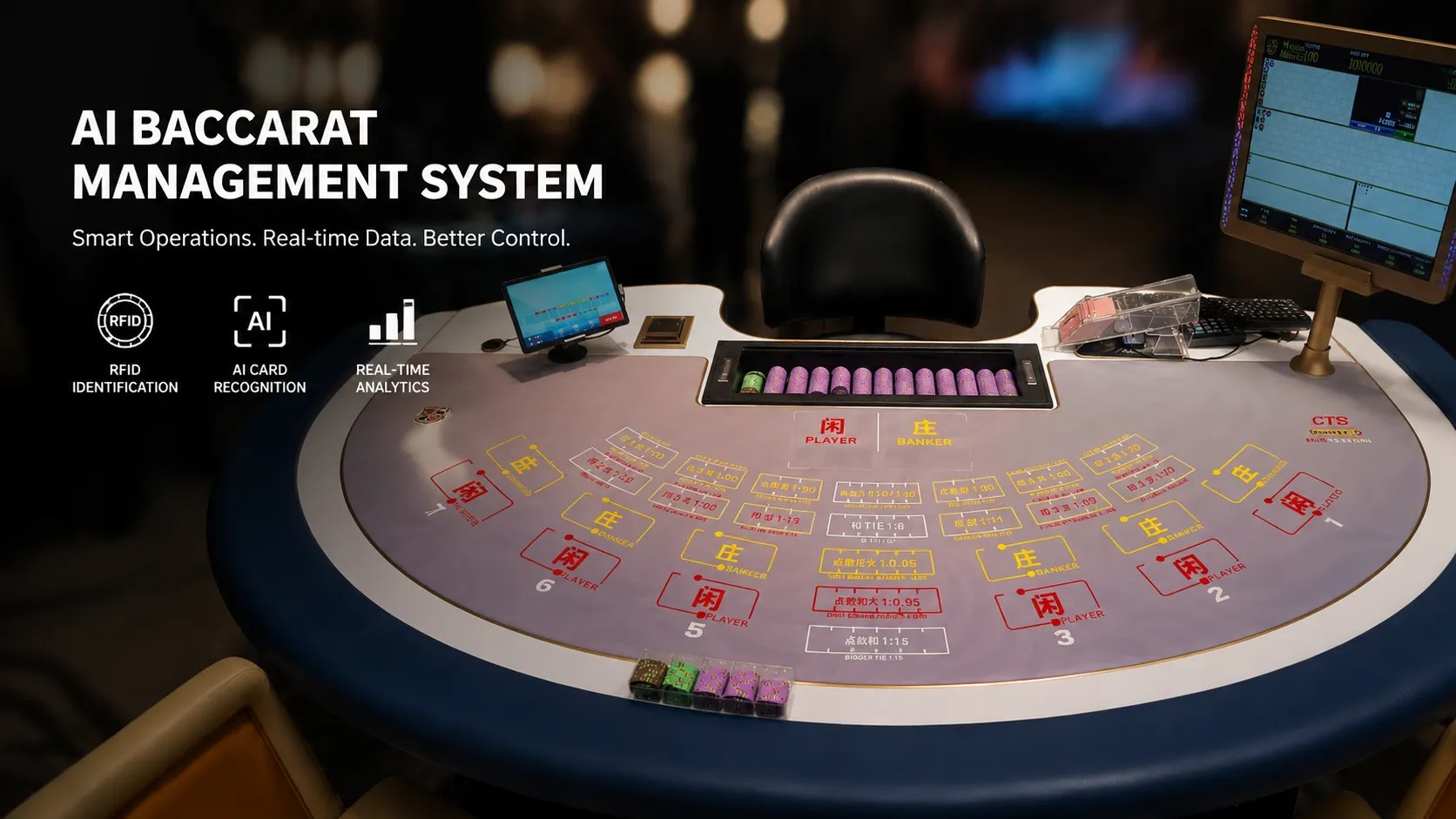
CTSOK’s system combines RFID chip identification with intelligent table management, AI-assisted game recognition, real-time monitoring, automated reconciliation, commission settlement, reporting and shift handover workflows.
A closed revenue-control process connects what was wagered, what result occurred, what should have been collected or paid, and what the dealer actually confirmed.
If these events remain in separate systems, management may receive several individually plausible records that do not agree with one another. A centralized platform creates value by comparing the records and retaining any inconsistency for review.
At the beginning of a shift or operating session, the table inventory establishes the baseline for all subsequent calculations.
The dealer or authorized employee opens the table session, and the system records the recognized tray inventory by denomination, quantity and value. A physical count can still be completed according to the casino’s internal procedures, while the RFID record provides an additional source for verification.
If the physical count and the system inventory do not agree, the issue can be investigated before the first wager is accepted. Without this opening check, a pre-existing inventory error may later be attributed incorrectly to a payout or chip transfer.
Established table-game controls also emphasize independent verification. Nevada’s current internal control procedures require each table’s chip, token and coin inventory to be counted and recorded at the close of a shift, with controls separating the employees performing the count from personnel able to change computerized inventory records.
When players place their bets, compatible table readers identify the RFID chips inside configured betting areas.
The important point is not merely that a chip has been detected. The system must associate that detection with a defined betting position and a specific game round.
For example, detecting a $500 chip somewhere on a baccarat table is not equivalent to recording a $500 Banker wager during round 108. The second record contains enough operating context to support later settlement verification.
A complete wager record may include the recognized chip value, betting zone, table, round, time and applicable player or table-session reference. If the detected amount does not agree with the visible wager or dealer confirmation, the difference can be addressed while the round is still active.
CTSOK RFID casino chips use individual electronic identification and can be integrated with compatible trays, table readers and centralized management software. The chip provides the identifiable physical asset, while the management system connects it to the relevant operating process.
A wager cannot be reconciled until the system has a reliable result for the game.
In baccarat, the result may be supplied by a compatible electronic card shoe, card-reading equipment, dealer confirmation, AI-assisted visual recognition or a combination of these sources.
CTSOK’s AI recognition functionality is designed to assist with game-result verification and operational monitoring. Its electronic card shoe can also form part of the connected table environment by providing card information to the management platform.
The system can compare the result generated by connected equipment with the result confirmed at the dealer terminal. When the records agree, the round continues through the normal settlement process. When they do not agree, the system can preserve the round as an exception requiring supervisory review.
AI-assisted recognition should operate as an additional verification layer rather than an unquestioned final authority. Card visibility, equipment communication, operating sequence and table conditions may affect automated recognition, so the platform should retain both the machine-generated result and the authorized human confirmation.
Once the wager and game result are known, the management system calculates what should happen financially under the configured game rules.
For a baccarat round, the calculation may include Player, Banker, Tie and side-bet outcomes, commission or no-commission rules, table limits, promotional-chip restrictions and other project-specific conditions.
The dealer then completes the physical collection and payout and confirms the operation through the dealer terminal or connected table equipment.
The system compares the theoretical settlement with the confirmed operation and the resulting table inventory change. If the expected collection or payout does not match the recorded result, the round can be flagged before the difference is absorbed into the rest of the shift.
This is where a management system provides more value than basic chip tracking. RFID can identify which chips were detected. The settlement logic determines whether their movement was consistent with the wager and confirmed game result.
Revenue control does not end after one game round.
Chips continue to move through table fills, table credits, cage transactions, redemptions, chip exchanges and shift handovers. Each movement changes the accountability of at least two operating areas.
Nevada’s table-game procedures require fills and credits to be authorized, documented and associated with specific tables, shifts, denominations, amounts, dates and times. The procedures also require chips to be verified by the dealer and signatures from responsible personnel involved in the transfer.
A connected system can compare the value authorized for transfer with the value released by the cage and received at the destination table.
If a cage records a $100,000 fill but the destination table recognizes only $95,000, the difference can be linked to that specific transfer. Without connected records, the same discrepancy may appear several hours later as a general cage or table shortage.
CTSOK supports chip issuance, redemption, reconciliation, centralized reporting, commission settlement and rapid shift handovers within the same operating platform.
Assume that a player places RFID chips representing $5,000 on Banker.
The table reader associates those chips with the Banker betting area and the current round. The connected card equipment and dealer terminal then confirm a Banker result. The system applies the configured commission and payout rules and calculates the theoretical settlement.
If the dealer’s confirmed operation and the resulting tray value match the expected amount, the system closes the round without creating an exception.
If the platform records only $4,750 returning to the tray when the configured rules require a $5,000 collection plus the applicable commission treatment, it creates a $250 discrepancy linked to that table and round.
The alert does not automatically prove theft or deliberate misconduct. The supervisor may discover that a chip was positioned outside the reading area, the wager was adjusted, a reader temporarily failed, or a supervisor-authorized correction had not yet been entered.
The important difference is that the investigation begins with a defined transaction rather than an unexplained end-of-shift shortage.
A casino management system cannot guarantee that every operating loss will be prevented. It can convert many previously invisible problems into structured exceptions that management can investigate.
Common examples include:
Wager recognition differences: The chip value detected in a betting zone does not match the value confirmed by the dealer.
Result and payout mismatches: The confirmed result does not agree with the collection or payout completed at the table.
Incorrect payout ratios: A side bet, special wager or no-commission outcome is settled using the wrong rule.
Duplicate or incomplete settlements: A winning position is paid twice, or a losing wager is not fully collected.
Fill and credit discrepancies: The amount released by one operating area does not match the amount received at another.
Promotional-chip processing errors: A nonredeemable or restricted chip is handled as ordinary cash value.
Commission differences: The system identifies a missing, duplicated or incorrectly calculated commission entry.
Retirement and inventory differences: A damaged chip is physically removed but remains active in the digital inventory.
Shift-handover gaps: The opening inventory, recorded activity and closing count do not form a complete reconciliation.
Each exception should retain enough context for an authorized reviewer to understand what occurred and what evidence remains available.
Not every valid casino chip should follow the same accounting and redemption rules.
Cash-value chips are normally redeemable according to the operator’s procedures and applicable regulations. Promotional, nonnegotiable or campaign chips may be restricted by validity period, eligible games, player account, transferability, redemption conditions or commission rules.
A promotional chip can be physically authentic while still being processed incorrectly. It may be accepted for cash redemption, used in an ineligible betting area or included in a commission calculation intended only for cash-value activity.
Nevada’s table-game guidance separates actual drop and win reporting from promotional activity when investigating statistical fluctuations by game type, illustrating why promotional activity should not be merged uncritically with ordinary cash wagering data.
CTSOK’s management architecture can distinguish chip identities and categories within the backend, allowing cash-value and promotional chips to follow different operating rules while remaining part of one wider management environment.
This allows the system to identify not only counterfeit or inactive chips, but also valid chips being used under the wrong accounting treatment.
Casino chips are physical assets subject to wear, contamination, label damage and possible RFID tag failure.
When a chip is no longer suitable for play, removing it physically is only half of the process. Its digital status must also change through an authorized retirement workflow.
A practical retirement process should record:
The identity and denomination of the chip.
The reason it was removed from active play.
The employee who initiated the change.
The supervisor or department that approved the retirement.
The date on which the chip became inactive.
The final disposal, storage or destruction status.
The historical record should remain available after the chip becomes inactive. Otherwise, the operator loses part of the explanation for the inventory change.
A chip stored in a damaged-item container but left active in the database creates false inventory. A chip destroyed without a matching retirement record creates an unexplained reduction. Both conditions can distort management reports even when no theft occurred.
AI-assisted monitoring can identify patterns that would be difficult to review manually across every table and game round.
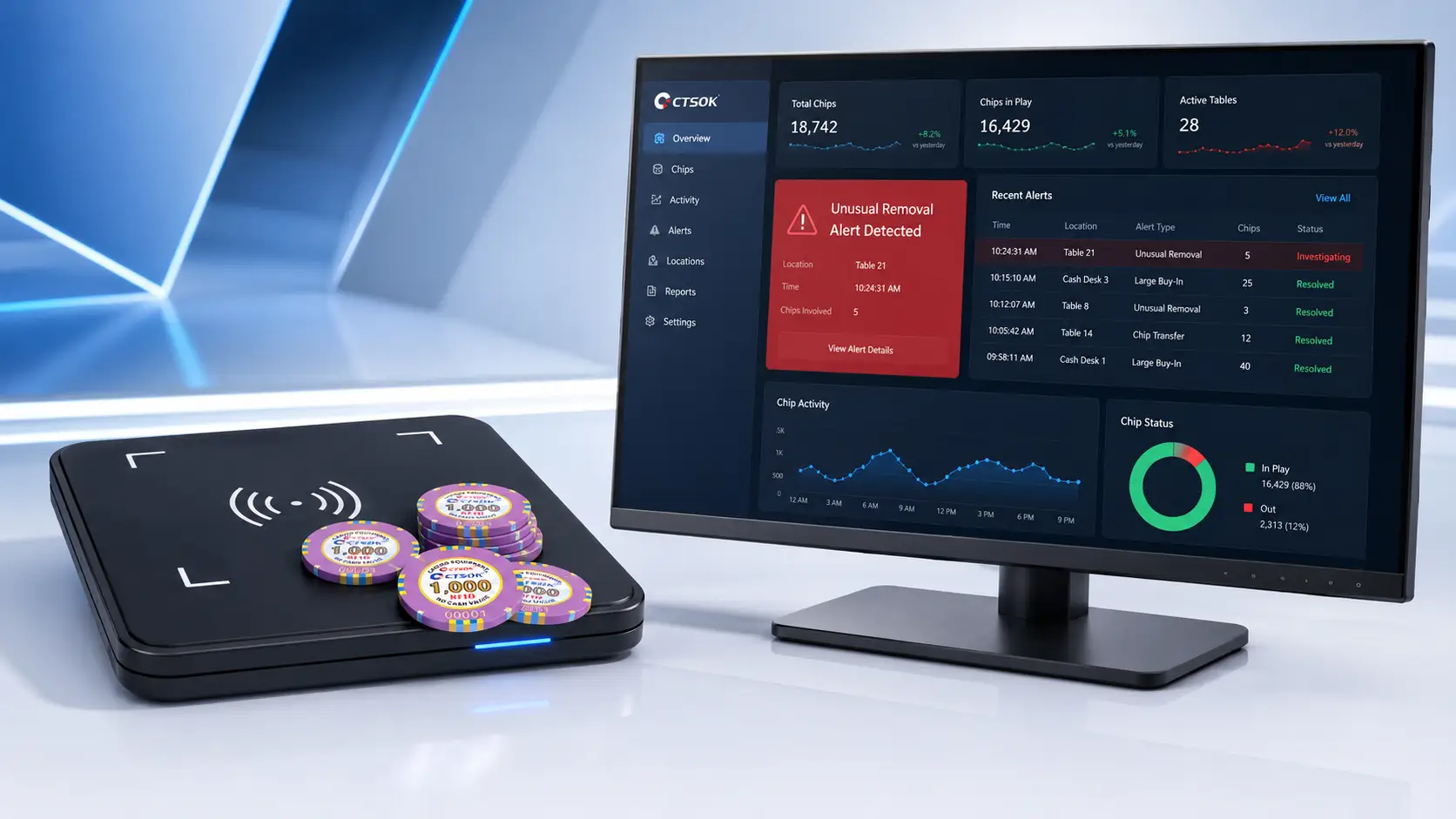
The system may detect repeated payout differences at one table, frequent disagreement between the dealer terminal and recognition equipment, unusual chip activity during shift changes or recurring errors involving one chip category.
These patterns help management prioritize investigations. They should not be treated as automatic proof of fraud or misconduct.
An exception may be caused by:
Reader interference or incorrect antenna calibration.
Chips positioned across two detection zones.
Delayed dealer confirmation.
A cancelled or adjusted wager.
Equipment communication failure.
A supervisor-approved correction.
An incorrectly configured payout rule.
A responsible workflow records the exception, preserves the related system data and assigns the case to an authorized reviewer. The reviewer can then examine table records, equipment status, employee actions and surveillance footage before documenting the cause and resolution.
CTSOK combines RFID data, AI-assisted result verification and abnormal-activity alerts with centralized operational records and permission-based management.
There is no verified public chip-shrinkage percentage that can be applied to every casino.
Properties differ in table count, chip float, denomination structure, operating hours, game mix, staffing, internal controls and existing technology. For that reason, the figures below should be treated as an illustrative planning model, not as audited industry-wide benchmarks.
| Financial Measure | Illustrative Planning Range |
|---|---|
| Active chip float | Approximately $2,000,000 |
| Annual unreconciled variance before deployment | $50,000–$300,000 |
| RFID system implementation cost | $150,000–$400,000 |
| Annual unreconciled variance after deployment | $5,000–$30,000 |
| Potential direct annual improvement | $20,000–$295,000 |
| Possible payback from variance reduction alone | Approximately 6 months to 20 years |
The broad payback range is important. A property with substantial unexplained differences and a focused deployment may recover the investment relatively quickly. A casino that already maintains strong manual controls and experiences only limited variance may require a longer period to justify the same infrastructure.
A six-to-eighteen-month payback may be possible when the property begins with relatively high unreconciled losses, controls the initial deployment scope or includes measurable savings from counting, reconciliation, reporting and investigation work. It should not be presented as a guaranteed result for every project.
Consider a property that currently records approximately $180,000 in annual unexplained chip and settlement differences.
After deploying an integrated RFID management system, the annual unresolved amount falls to $30,000. The direct annual improvement is therefore $150,000.
If the total implementation cost is $225,000:
Simple payback period = $225,000 ÷ $150,000 = 1.5 years, or approximately 18 months.
This calculation does not include any additional economic benefits from faster tray counts, shorter investigations, reduced spreadsheet consolidation, more efficient shift handovers or quicker audit-report preparation.
The example is useful because its assumptions are visible. It does not claim that every casino will achieve the same result.
A reliable financial assessment should begin with the casino’s own operating records rather than a generic industry percentage.
Before requesting a system proposal, management should collect at least twelve months of data covering:
The total value of unexplained chip and settlement differences.
The number of exceptions identified by table, game and shift.
The average time required to investigate each discrepancy.
The staff hours used for tray, cage and vault counts.
The labour required to consolidate reports and spreadsheets.
The number of incorrect cash-value or promotional-chip transactions.
The number of damaged chips awaiting retirement.
The frequency of fill and credit corrections.
The time required to complete shift handovers.
The proportion of exceptions that can be resolved with complete transaction evidence.
These measurements create a defensible baseline.
After deployment, success should not be evaluated only by asking whether fewer chips are missing. The operator should also determine whether discrepancies are identified sooner, investigations take less time, reports contain more complete records and management can explain a larger percentage of inventory and settlement changes.
Purchasing RFID chips and readers is not the same as implementing a revenue-control system. The technology must be configured around the casino’s actual operating procedures.
Before the new platform becomes the official source of record, the operator should reconcile the physical inventory with the master chip database.
The baseline should confirm chip identities, denominations, categories, activation status, assigned locations and existing damaged or discontinued inventory.
Starting with an inaccurate baseline causes future reports to reproduce the original errors.
Readers should be installed according to the operating event the casino needs to capture.
Potential control points include cage and vault areas, chip trays, betting zones, fill and credit transfer points, redemption counters and damaged-chip storage areas.
More readers do not automatically create better control. Overlapping detection zones or poorly positioned antennas may produce ambiguous records. Each reader should have a clearly defined operational purpose.
The software must reflect the property’s real operating model, including its games, betting zones, payout ratios, commission structure, table limits, promotional-chip rules, user permissions, fills, credits, reporting requirements and retirement procedures.
CTSOK’s platform can be configured according to different gaming environments and management objectives, rather than applying one fixed table model to every project.
Employees need clear instructions explaining how each type of system exception should be handled.
The operating procedure should define who receives the alert, who may approve or override a record, when a supervisor must become involved, when surveillance review is required and how the final explanation should be documented.
Without this operational integration, alerts may accumulate without producing any meaningful improvement in control.
An RFID chip provides an electronic identity. That identity becomes financially useful only when the management platform connects it with the operating event that explains its movement.
Once detected chips are associated with a specific betting area and round, the system can compare the wager with the confirmed game result and theoretical settlement. It can then compare the expected collection or payout with the dealer-confirmed operation and the resulting table inventory.
If those records do not agree, the platform creates an exception at the point where the inconsistency first appears. Management no longer has to wait for a shift shortage before beginning the investigation.
CTSOK’s casino management architecture brings together RFID chip identification, intelligent table management, AI-assisted result verification, automated reconciliation, commission settlement, chip issuance and redemption, shift handover, permission control and centralized reporting. These components are designed to operate as one configurable environment rather than as unrelated hardware and software products.
The system does not remove the need for dealers, supervisors, cage personnel, surveillance teams or auditors. It gives those employees a more complete record of what occurred and reduces the amount of gaming activity that remains unexplained.
Hidden revenue gaps persist when each department holds only part of the operating record.
The table records the wager. The card equipment provides game information. The dealer completes the settlement. The chip tray reflects an inventory change. The cage records what was issued or redeemed. Finance reviews the final balance.
A casino management system creates value by connecting these records and testing whether they tell the same story.
When the wager, result, theoretical settlement, dealer confirmation and inventory change agree, management has a defensible record of the transaction.
When they do not agree, the system identifies a specific exception that can be investigated before it disappears into a larger shift or monthly variance.
RFID technology makes the physical chip identifiable. The management platform explains how that chip relates to table activity and revenue.
For casino operators, the objective is therefore not simply to count chips faster. It is to create a reliable chain of evidence showing how gaming revenue was generated, settled, transferred and reconciled.
Interested in our products? Click the button below to book a demo or get more information