Casino chips that look similar may follow completely different financial and operating rules.
A cash-value chip normally represents value that the issuing casino can redeem under its approved procedures. A promotional chip may carry a printed number for use during play, but its use and redemption are controlled by the terms of a promotion, tournament or another defined program.
Nevada’s chip regulations illustrate this distinction clearly. Ordinary casino chips are described as representatives of value, and licensees are generally required to redeem their own approved chips for cash or check. Promotional chips are treated separately: they must display “No Cash Value” on both sides and cannot be used outside the promotion or tournament for which they were issued. These are Nevada-specific requirements rather than universal international rules, but they demonstrate why casinos must keep the two chip categories separate.
With traditional chips, the distinction depends mainly on visible design, staff procedures and manual records. RFID technology adds another layer. Each chip can be connected to a unique electronic identity, while the management system assigns that identity a defined chip category and operating value.
The result is not simply a chip that can be scanned. It is a chip whose physical markings, RFID identity and backend record can work together.
In this article, “cash-value chip” refers to a standard gaming chip that represents an amount recognized by the issuing casino and is handled through its normal issuance, table-use and redemption procedures.
The exact legal terminology varies by jurisdiction. In Nevada, a chip is defined as a representative of value issued for use at the licensee’s table or counter games. The issuing licensee is generally required to redeem its own chips from eligible patrons, subject to the applicable regulations and internal controls.
Operationally, a cash-value chip may move through several areas:
It is recorded in the casino’s chip inventory.
It is issued through the cage or table-bank process.
It enters play at an approved table.
It may be used for wagers, payouts or chip exchanges.
It is returned to the cage, table bank or inventory.
It is reconciled against operational records.
Because it represents a financial liability to the issuing operator, its issuance, circulation and redemption must be accounted for consistently.
A promotional chip is issued for a defined campaign, tournament, rolling-chip program or other controlled activity rather than for unrestricted use as an ordinary redeemable chip.
The precise rules depend on the jurisdiction and the operator’s approved internal controls. Nevada Regulation 12 defines a promotional chip as a chip-like object issued for promotions or tournaments. It requires the “No Cash Value” inscription and limits the chip to the activity for which it was issued.
The Nevada Gaming Control Board also explains that non-negotiable chips may be provided to patrons as promotional payouts for gaming activity even though the chips themselves have no monetary value outside the gaming establishment. Their use can still produce winnings that affect table-game revenue.
This distinction is important:
The promotional chip itself may not be cash-redeemable.
A player may still use it in an approved gaming activity.
Any winnings produced through that activity are handled according to the promotion’s rules and the operator’s internal controls.
A printed denomination on a promotional chip can therefore indicate its permitted wagering value without automatically making the chip redeemable for the same amount in cash.
The words “No Cash Value” are not merely decorative text.
They communicate that the chip should not be processed in the same way as an ordinary cash-value chip. Depending on the applicable rules, the chip may be intended for:
a promotional campaign;
a tournament;
a rolling-chip program;
dealer training;
product demonstrations;
smart-table testing;
RFID reader testing;
private entertainment projects;
another controlled gaming activity.
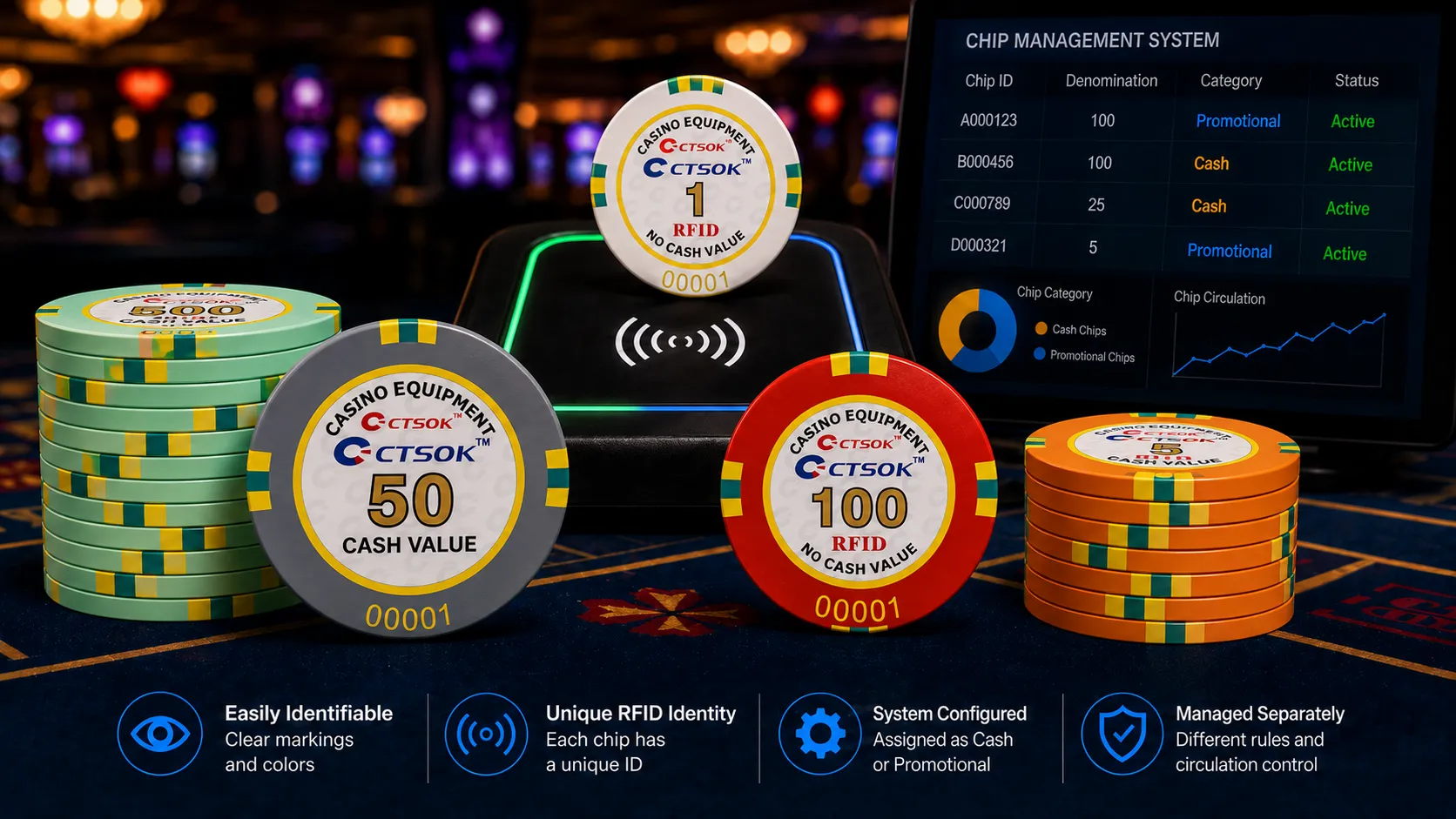
The CTSOK 1 Value RFID Casino Chip includes visible denomination marking, a printed serial reference, RFID identification and “No Cash Value” wording. The label, artwork and wording can also be adjusted for a licensed project according to the operator’s local rules and internal controls.
However, printed wording alone does not create a complete management system. Staff can see the label, but connected equipment also needs a reliable way to identify the chip electronically.
The CTSOK product structure can distinguish cash-value and promotional chips through three connected layers.
The first layer is the physical design that dealers, cage staff and supervisors can see.
Depending on the project, visible information may include:
denomination;
body color;
edge-insert colors;
casino or operator logo;
printed serial number;
promotional artwork;
“No Cash Value” wording;
security printing or marking.
Visible differences remain important even when RFID is installed. Staff still need to recognize a chip without placing it on a reader every time.
The 1-value CTSOK chip, for example, combines a white body, colored edge inserts, a visible value number, printed identification and “No Cash Value” wording. Custom options include the denomination, colors, artwork, numbering format and redemption wording.
The second layer is the RFID identifier embedded in the chip.
A visible chip may show “1,” “5” or “100,” but the RFID reader does not rely only on the printed number. It reads the chip’s electronic identity. That identifier can then be matched with the corresponding record in the management platform.
CTSOK’s RFID casino chips are designed to work with unique chip identification, batch recognition and connected management systems. HF or UHF configurations can be selected according to the reader, protocol and project requirements rather than assuming that every installation uses the same RFID format.
The identifier answers one basic question:
Which individual chip has entered the reading area?
It does not, by itself, determine whether the chip is cash-redeemable. That meaning comes from the chip record associated with the identifier.
The third layer is the backend configuration.
CTSOK’s current RFID-1 product specification states that chips can be configured in the backend system as either cash chips or promotional chips. The two categories can then be separately identified and managed for regular table play, promotional campaigns and rolling-chip programs.
A simplified chip record may connect the electronic identity with information such as:
| Record field | Operational purpose |
|---|---|
| RFID identity | Identifies the individual physical chip |
| Printed number | Provides a visible manual reference |
| Denomination or system value | Tells the system what value is assigned |
| Chip category | Distinguishes cash-value from promotional use |
| Series or project | Connects the chip to a specific chip set |
| Current status | Supports active, inactive or other project-defined handling |
| Issuance record | Shows when the chip entered the operating process |
| Inventory location | Associates it with a cage, table bank or another recorded area |
The exact fields and workflow depend on the final system configuration. The important product function is that the chip category is not inferred only from its color. It can be assigned to the RFID identity in the backend.
When the products are used as part of a connected RFID environment, the distinction can follow a straightforward process.
The operator confirms the required denomination, colors, serial format, artwork and any “No Cash Value” wording.
Cash-value and promotional chips can use clearly different designs, although visual differences alone are not the complete electronic control method.
Each chip receives or exposes an electronic identifier compatible with the selected RFID configuration.
The printed serial number and RFID identity can provide two reference layers:
the printed number for staff and manual records;
the RFID identity for electronic recognition.
CTSOK’s 1-value product is specifically designed with both visible serial identification and RFID-based identification.
The corresponding backend record is configured as cash or promotional.
This is the point at which two physically similar RFID chips can be given different operational meanings. One record can belong to the standard cash-value inventory, while another belongs to a promotional campaign or rolling-chip program.
When the chip enters a compatible reader, chip tray, smart table or other reading point, the equipment captures its electronic identity.
The reader does not need to guess the chip category from the printed artwork. The connected software retrieves the record associated with the electronic identifier.
The management interface can identify whether the detected chip belongs to the cash or promotional category.
This allows the operator’s workflow to treat the two inventories separately during activities such as:
chip issuance;
inventory counting;
table-bank management;
campaign distribution;
reconciliation;
redemption review;
shift handover;
operational reporting.
CTSOK’s casino management system supports RFID chip tracking together with operational workflows including issuance, redemption, reconciliation, reporting and shift handovers.
Consider two RFID chips that both display the number 100.
Its RFID identity is registered in the standard cash-value chip inventory.
When read by connected equipment, the backend record identifies it as:
denomination: 100;
category: cash chip;
use: regular table operations;
workflow: standard issuance, circulation and redemption process.
Its RFID identity is registered in a promotional chip series.
Its visible design may include “No Cash Value,” a campaign-specific color or different artwork. When read, the backend record identifies it as:
promotional wagering value: 100;
category: promotional chip;
use: designated campaign or program;
workflow: separate promotional issuance and reconciliation.
The two chips may represent the same amount for an approved wager, but they are not necessarily financially interchangeable.
The difference is established through the combined use of:
visual markings;
unique RFID identities;
separate backend records.
Color is useful for quick recognition, but it is not a complete management control.
Two chip series may use similar colors. A promotional campaign may reuse an existing denomination structure. Chips can also be stacked with only part of the edge visible. Staff may therefore need to rely on several identifiers rather than a single visual characteristic.
RFID allows the system to distinguish individual chips even when:
the printed denomination is the same;
the chips are stacked;
the promotional series uses a similar color;
multiple chip categories are counted together;
staff need to verify the inventory electronically.
This does not eliminate the need for clear physical design. It adds an electronic reference to the visible one.
An RFID chip does not become promotional merely because “No Cash Value” is printed on it, and it does not become cash-redeemable merely because it carries a denomination.
The connected system must be configured correctly.
The product configuration should define:
which chip identities belong to the cash inventory;
which belong to a promotional or rolling-chip series;
what value is associated with each category;
which operational workflow should process the chip;
how issuance and reconciliation records are handled;
what the operator’s internal controls require.
Similarly, RFID identification should not be described as continuous GPS tracking. A chip is detected when it enters a configured reading environment, such as a compatible reader, tray or smart-table zone. What the system records depends on the installed hardware, integration scope and backend workflow.
When cash-value and promotional chips are mixed into one undifferentiated record, several operational questions become harder to answer:
How many redeemable chips are currently outstanding?
How many promotional chips were issued for a campaign?
How many promotional chips have entered play?
Which chips remain in inventory?
Were promotional chips accidentally counted as cash-value assets?
Which records should enter standard redemption reconciliation?
Backend classification gives the operator a clearer basis for separating these records.
The classification does not replace the casino’s approved accounting procedures. It gives those procedures a more precise source of chip-identification data.
The RFID chip provides the electronic identity, but the management platform gives that identity operational meaning.
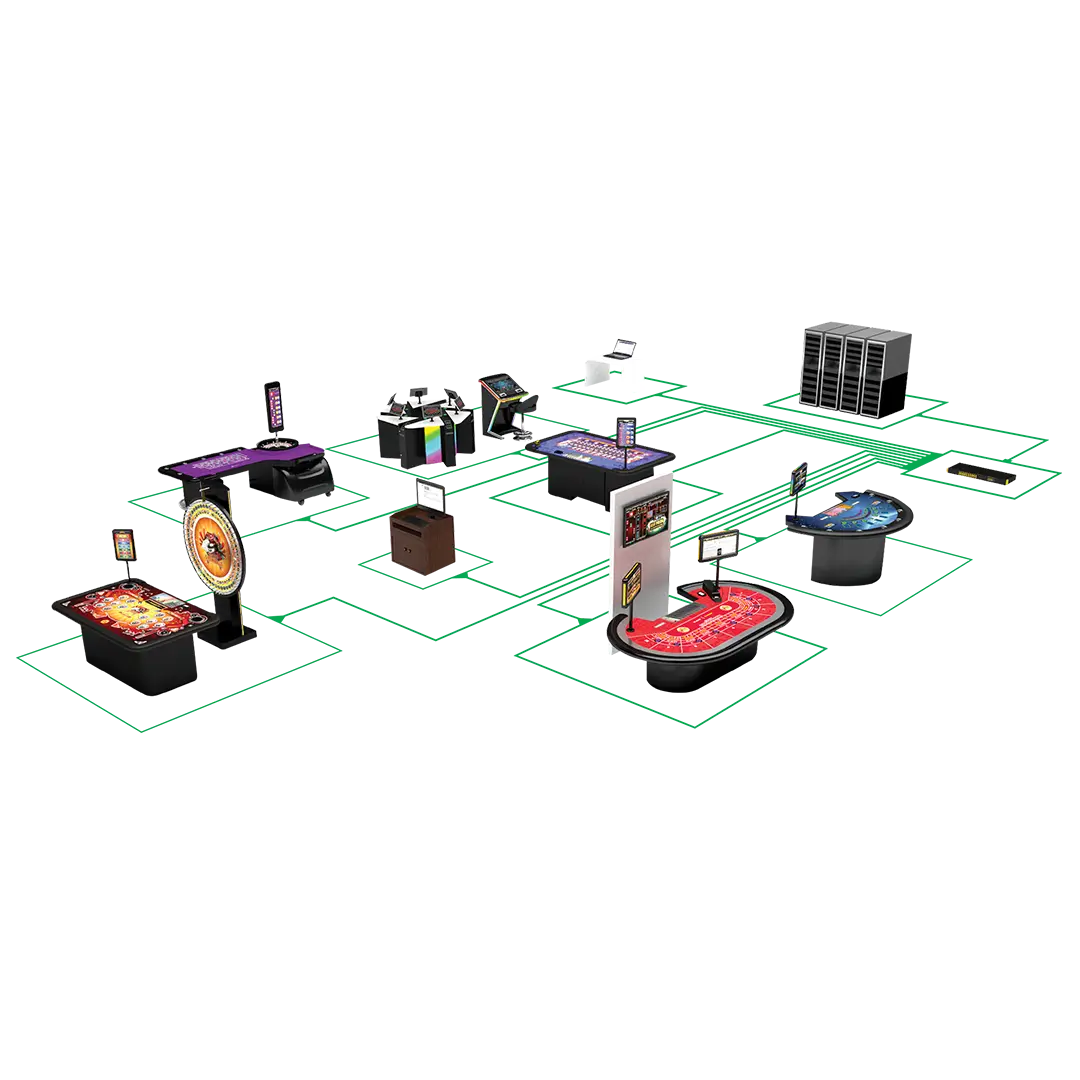
CTSOK’s system connects RFID chip identification with table activity, inventory visibility and operational workflows. Its publicly listed capabilities include chip movement monitoring, chip issuance, redemption, reconciliation, reporting and shift management.
For cash and promotional chip management, the practical relationship is:
Physical chip → RFID identity → backend category → operating workflow
Without the physical chip, there is no gaming instrument.
Without the RFID identity, the system cannot reliably identify the individual chip electronically.
Without the backend category, the electronic identity does not explain whether the chip belongs to cash-value or promotional inventory.
All three parts are required for clear system-based separation.
There is no single worldwide rule covering every casino chip.
Requirements for chip approval, redemption wording, promotional use, security design, issuance and disposal vary between jurisdictions. Nevada requires promotional chips to display “No Cash Value” on both sides and limits them to their approved promotion or tournament, but another market may use different terminology or approval procedures.
For licensed casino projects, operators should confirm:
the regulator’s chip-design requirements;
whether promotional chips require specific wording;
permitted uses and redemption restrictions;
approval requirements for new or modified chip designs;
internal-control requirements for issuance and reconciliation;
retention or disposal procedures after a campaign ends.
CTSOK can customize the chip label, serial format, denomination, RFID protocol and UID mapping structure, but the final configuration must follow the operator’s approved regulatory and internal-control framework.
Cash-value and promotional RFID casino chips are not distinguished by one feature alone.
A reliable configuration uses three connected forms of identification:
Visible design, including denomination, color, serial reference and “No Cash Value” wording where applicable.
Unique RFID identity, allowing compatible equipment to identify the individual chip electronically.
Backend configuration, assigning the chip to the cash or promotional category and connecting it to the appropriate management workflow.
CTSOK’s RFID chip platform supports this separation by allowing chips to be configured as cash or promotional in the backend system. The system can then identify and manage them separately for regular table use, promotional campaigns and rolling-chip programs.
This approach does not change the physical way players place chips on a table. It changes what the management system knows about each chip—and helps operators avoid treating two visually similar gaming instruments as the same type of financial asset.
Interested in our products? Click the button below to book a demo or get more information