

Professional Solutions for Casino Asset Management
CTS's RFID Casino Management System, specifically designed for casino clients, utilizes advanced technology and premium materials to deliver a durable and reliable professional asset management solution.
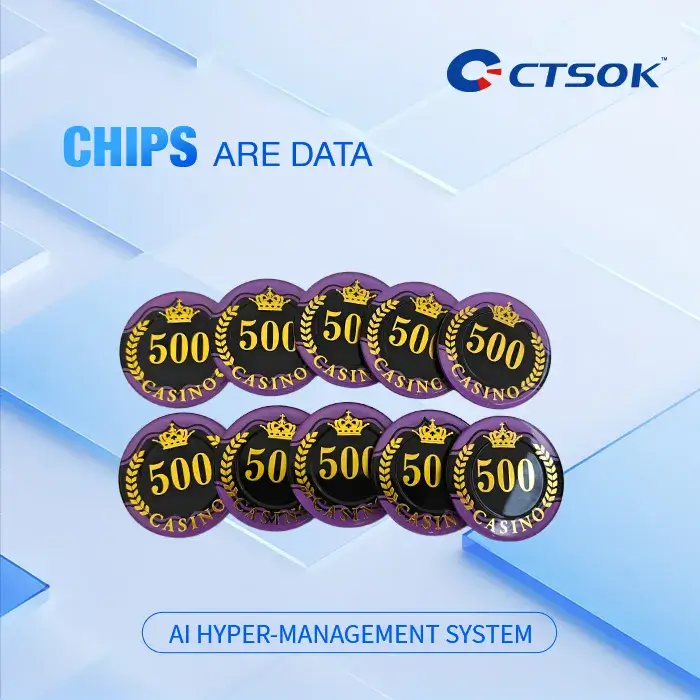
RFID Clay Composite Poker Chips | Multi-Denomination Smart Casino Set
CTSOK RFID Clay Composite Poker Chips combine a traditional round chip format with compression-molded clay composite construction, bold white edge stripes, coordinated denomination colors, and optional embedded RFID identification. The series is designed for casinos, poker rooms, VIP gaming areas, tournaments, training rooms, and CTSOK smart chip-management projects.
Bulk purchases for entertainment venues qualify for greater discounts | Customization services available
Core Features
Compression-Molded Clay Composite
Provides a denser and more substantial handling feel than lightweight plastic tokens.
Classic 39 mm Round Format
Suitable for standard chip stacking, storage, dealing, and table-side handling.
Bold White Edge Stripes
Repeated white markings remain visible along the side of organized chip stacks.
Color-Coded Denomination Range
Each value uses a distinct body color while retaining one coordinated design system.
CTS Services
Customized Services
7 × 24 Technical Support
Visual Management
RFID chips
About CTS
CTS is dedicated to RFID technology innovation and application, providing professional intelligent solutions for global customers
-
Technology Innovation - Own multiple core patents, continuously driving industry development
-
Quality Assurance - Strict quality control system, stable and reliable products
-
Custom Service - Personalized solutions based on customer needs
-
Professional Service - Professional technical team provides full service support
-
Global Presence - Business covers multiple countries and regions
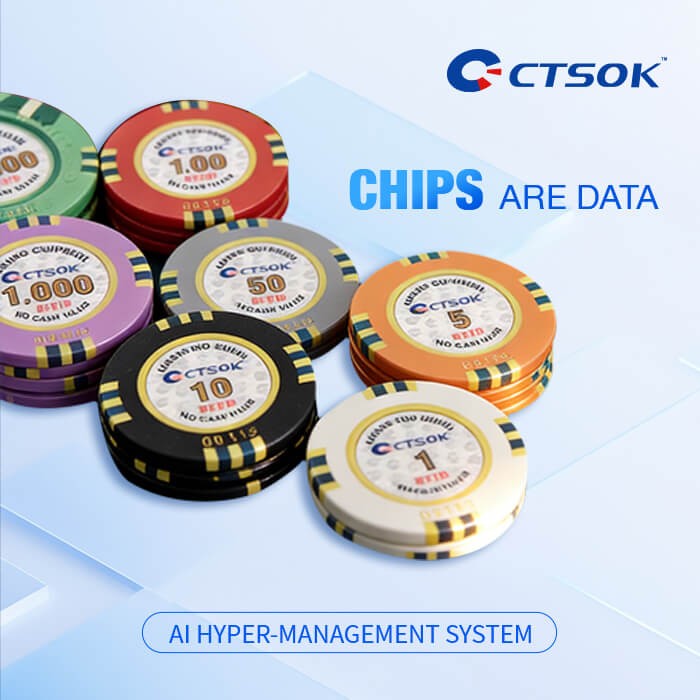
CTSOK RFID Clay Composite Poker Chips are designed for projects that require the familiar shape and handling characteristics of round gaming chips while also supporting modern electronic identification. The product combines a compression-molded clay composite body with coordinated denomination colors, wide white edge stripes, customizable center artwork, and optional RFID technology.
The pictured series includes six clearly separated denominations:
50 — Purple
100 — Yellow
500 — Green
1,000 — Orange
5,000 — Blue
10,000 — Brown
Each denomination uses its own main body color, while the white edge markings, center-label structure, number placement, and decorative style remain consistent throughout the set. This creates a chip family that can be recognized as one product series without making the individual values look identical.
The product differs from CTSOK’s ceramic chip range in both construction and visual treatment. Ceramic chips are primarily suited to full-surface printed graphics, while this model uses a molded clay composite body with clearly defined edge markings and a separate center artwork area. The result is a more traditional casino-chip appearance with strong side recognition when chips are organized in stacks.
The standard round specification is 39 mm in diameter, with a reported weight range of 8–14 g and a thickness of approximately 3.3–3.5 mm. Alternative diameters can also be developed for customized projects. The final weight and dimensions should be confirmed according to the selected mold, material formula, RFID configuration, and approved production sample.
For connected CTSOK projects, an RFID inlay can be embedded during manufacturing. Each RFID-enabled chip can be assigned an electronic identity and linked to a configured denomination inside compatible management software. The final RFID frequency, protocol, encoding rules, and reader compatibility must be defined before production rather than assumed to be identical for every order.
Compression-Molded Clay Composite Construction
The chip body is produced from a clay composite material using a compression-molding process. The reference construction combines clay-based material with synthetic binders to form a dense, shaped chip body.
This structure gives the product a different character from:
Lightweight injection-molded plastic chips
Single-piece printed ceramic chips
Transparent acrylic chips
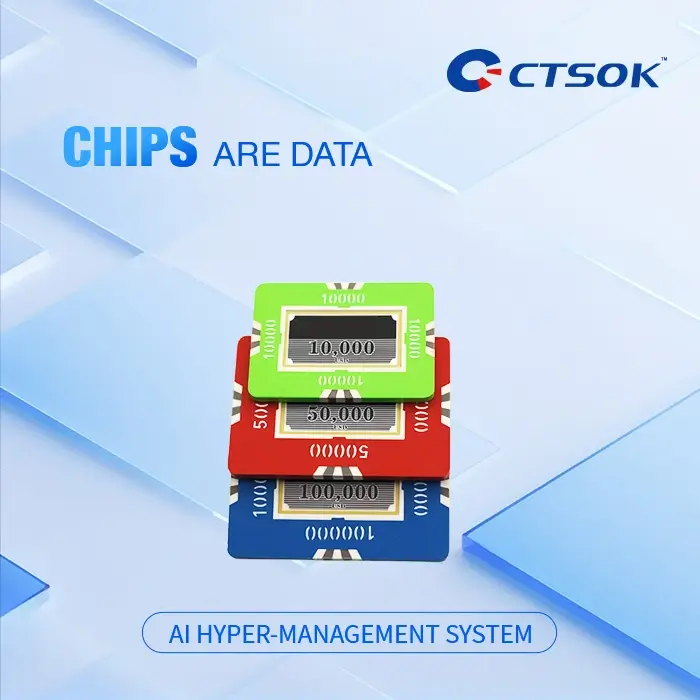
Large rectangular high-denomination chips
The molded body allows the main chip color and edge pattern to become part of the physical product design rather than being represented only through printed surface graphics.
For custom orders, the final material formula, chip weight, surface texture, edge profile, and center artwork should be reviewed through a physical sample before mass production.
Classic Round Chip Format
The pictured product uses the conventional round format associated with table-game and poker-chip handling.
The standard reference diameter is 39 mm, with additional size options listed as:
43 mm
45 mm
50 mm
55 mm
60 mm
The 39 mm format is the most appropriate starting point for a coordinated set such as the one shown in the image. Larger diameters can be used when a project requires greater visual separation, additional artwork space, or a distinct denomination category.
The final diameter should be selected together with the weight, thickness, chip tray, storage rack, and RFID reader configuration. Changing the chip size may also affect packaging quantity and handling characteristics.
Bold White Stripe Edge Design
The broad white edge stripes are the most recognizable visual feature of this specific design.
Each chip uses repeated white markings around the outer edge. When multiple chips are stacked, the center artwork is covered, but the main body color and white stripe pattern remain visible from the side.
This provides two complementary recognition methods:
Body color identifies the denomination group.
Printed center number confirms the exact value.
The white markings also provide consistency across the set. Although the 50, 100, 500, 1,000, 5,000, and 10,000 chips use different body colors, they remain visually connected through the same edge treatment.
The edge pattern can be customized through:
Stripe width
Number of stripe groups
Stripe color
Repeated symbols
Denomination-specific combinations
Edge text
Brand graphics
Security markings
Coordinated Six-Denomination Series
The supplied design uses a six-value progression:
50 → 100 → 500 → 1,000 → 5,000 → 10,000
This structure provides clear value steps for table-game, poker-room, tournament, training, and system-demonstration projects.
The pictured color assignments are specific to this CTSOK design and should not be described as universal denomination standards. Different operators may use different colors for the same values.
For customized production, CTSOK can retain the pictured series or develop another structure, such as:
1 / 5 / 25 / 100 / 500 / 1,000
10 / 50 / 100 / 500 / 1,000 / 5,000
50 / 100 / 500 / 1,000 / 5,000 / 10,000
Operator-defined values
The number of chips required for each denomination should be planned according to the tables, game format, starting inventory, operating procedures, and reserve stock rather than ordering equal quantities automatically.
Center Label and Custom Branding
Each chip includes a circular center artwork area surrounded by the molded body and edge design.
The pictured layout includes:
Poker wording
Large denomination number
Card-suit graphics
Casino Equipment wording
Decorative background details
Consistent typography across all values
For a customized CTSOK project, the center design can be adapted with:
Casino or poker-room logo
Operator name
Club identity
Denomination
Currency or non-currency wording
Custom card-suit pattern
Background graphics
Security text
Serial number
Tournament name
VIP-room designation
The denomination should remain the most readable element. Logos and decorative graphics should support the design without making the value difficult to identify during table operation.
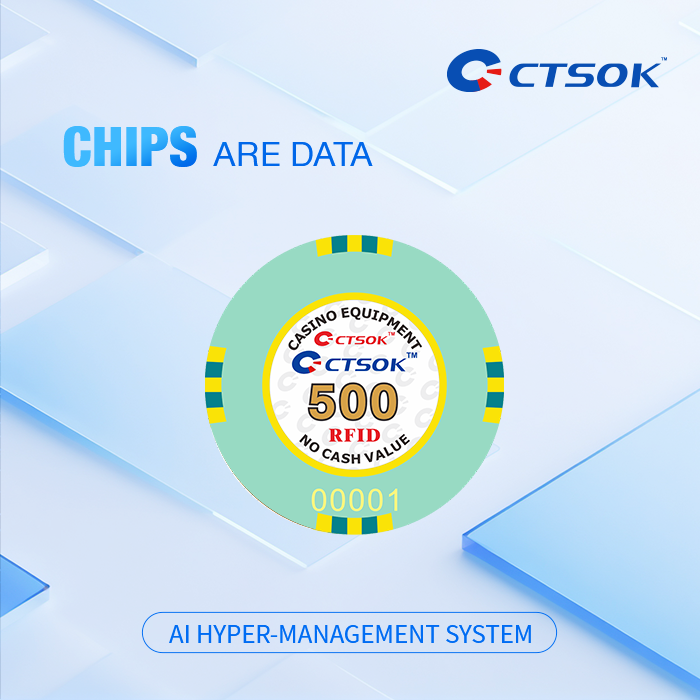
Optional RFID Identification
An RFID inlay can be embedded during manufacturing when electronic chip identification is required.
The product range supports configurable HF or UHF RFID, depending on the project. Each RFID-enabled chip can carry an electronic identifier that is associated with a system record.
A system record may define:
Chip denomination
Chip color
Printed reference number
Inventory category
Issue status
Table assignment
Cage status
Active or inactive status
Project-specific management fields
The RFID component does not independently provide complete tracking or reporting. Those functions depend on the reader hardware, antenna arrangement, software, database mapping, and operating workflow used in the final installation.
HF and UHF Project Configuration
HF and UHF serve different reading environments, so the correct configuration should be selected before production.
HF RFID
HF is commonly considered for controlled, shorter-range reading areas where chips are presented close to the reader.
Possible project equipment includes:
Cashier-side readers
Controlled inventory stations
Chip verification devices
Close-range chip trays
UHF RFID
UHF can be considered where wider reading coverage or multi-chip recognition is required, subject to the installed reader and antenna environment.
Possible project equipment includes:
Inventory reading areas
Table-side antenna systems
Chip movement checkpoints
Batch-reading equipment
CTSOK’s existing RFID chip platform lists both 13.56 MHz HF and 860–960 MHz UHF configurations. Compatibility should be confirmed against the actual management platform rather than relying only on the frequency name.
CTSOK “Chips Are Data” Integration
When ordered with RFID, the clay composite chip becomes more than a visually identified denomination.
Its electronic identity can provide a reference point for compatible CTSOK systems to process chip-related records. The wider CTSOK management architecture supports RFID chip identification, chip inventory visibility, table data collection, reconciliation, reporting, and shift workflows.
Possible connected components include:
RFID chip readers
Intelligent chip trays
Cage-side reading stations
Baccarat table management systems
Blackjack table management systems
Niu Niu table management systems
Chip issuance and return modules
Inventory databases
Reconciliation tools
Centralized management dashboards
This reflects the CTSOK Chips Are Data concept: the physical chip remains recognizable by color, value, and artwork, while its RFID identity allows compatible software to treat it as a defined operational asset.
Inventory and Denomination Recognition
A physical chip count does not by itself show the value composition of a mixed stack.
For example, ten physical chips may include several different denominations. When each RFID identity is correctly mapped, compatible software can distinguish:
Total chip quantity
Quantity of each denomination
Configured value of each denomination group
Combined value of the recognized set
Differences between expected and detected records
Unregistered or incorrectly configured chips
This can support inventory checking and reconciliation, but the accuracy of the result depends on correct chip encoding, reader coverage, database records, and operating procedures.
Optional Verification Features
The clay composite chip range can be configured with additional verification elements. Available options include RFID, UV marking, laser etching, and holographic labels.
UV Marking
Selected text, symbols, or patterns can be designed for inspection under suitable ultraviolet lighting.
Laser Identification
A serial number or verification mark can provide a visible physical reference for inventory and manual checking.
Holographic Element
A holographic label can add a visible optical verification feature to the center artwork.
RFID Inlay
The RFID component provides the electronic identification layer when used with compatible readers.
These features should be selected according to an actual verification procedure. Adding multiple security elements without defining how staff will inspect or manage them does not automatically improve operational control.
Custom Configuration Options
CTSOK RFID Clay Composite Poker Chips can be customized across the complete chip series.
Available options include:
Chip denomination
Main body color
White or custom edge stripes
Edge-spot structure
Center-label artwork
Casino or poker-room logo
Printed wording
Card-suit graphics
Serial numbering
Diameter
Thickness
Weight
RFID frequency
RFID protocol
Encoding rules
UV marking
Laser identification
Holographic elements
Packaging and chip-set quantities
The reference product range lists a typical custom-order MOQ of approximately 300–1,000 chips per denomination, depending on the level of customization. Final quantities should be confirmed in the CTSOK quotation.
Suitable Applications
The RFID Clay Composite Poker Chips are suitable for:
Commercial casino projects
Poker rooms
VIP gaming rooms
Card clubs
Tournament operations
Cruise ship gaming projects
Dealer training rooms
Casino-equipment showrooms
RFID chip-management demonstrations
Smart table integration projects
Customized branded chip sets
Their principal distinction is the combination of compression-molded clay composite construction, a classic round format, bold stack-visible white edge stripes, coordinated denomination colors, customizable center artwork, and optional CTSOK RFID integration.
Technical Specifications
| Parameter | Product Information |
|---|---|
| Product Name | RFID Clay Composite Poker Chips |
| Recommended Model | RCC-39S |
| Product Type | Round clay composite casino and poker chips |
| Material | Compression-molded clay composite |
| Standard Diameter | 39 mm |
| Additional Diameters | 43 / 45 / 50 / 55 / 60 mm |
| Standard Round Thickness | Approximately 3.3–3.5 mm |
| Weight Range | Approximately 8–14 g, depending on size and format |
| Edge Design | Wide repeated white stripe pattern |
| Pictured Denominations | 50 / 100 / 500 / 1,000 / 5,000 / 10,000 |
| Pictured Colors | Purple / yellow / green / orange / blue / brown |
| Center Artwork | Custom logo, value, wording, pattern, and card-suit graphics |
| RFID Configuration | Optional HF or UHF RFID inlay |
| Electronic Identity | Configured according to project requirements |
| Verification Options | RFID, UV marking, laser identification, holographic label |
| Typical Custom MOQ | Approximately 300–1,000 pieces per denomination |
| Main Applications | Casinos, poker rooms, VIP rooms, tournaments, training, and system projects |
Why Choose CTS
CTS focuses on providing high-quality RFID asset management solutions for enterprises, committed to helping customers achieve digital transformation
Leading Technology
Industry-leading RFID technology team, continuous innovation, providing customers with the highest quality products and services
Global Service
Services cover multiple countries and regions, providing customized localized services for different customers
Professional Team
Experienced professional team providing comprehensive technical support and service guarantee
Free Consultation
Fill out the form below, our professional consultant will contact you within 24 hours
Contact Us
Phone
+853 6860 5104
info@ctsok.com
Business Hours
Mon-Fri 9:00-18:00
+85368605054
Address
2-4 SHEUNG HEI STREET, SAN PO KONG, KOWLOON, HONG KONG
Quick Response Commitment