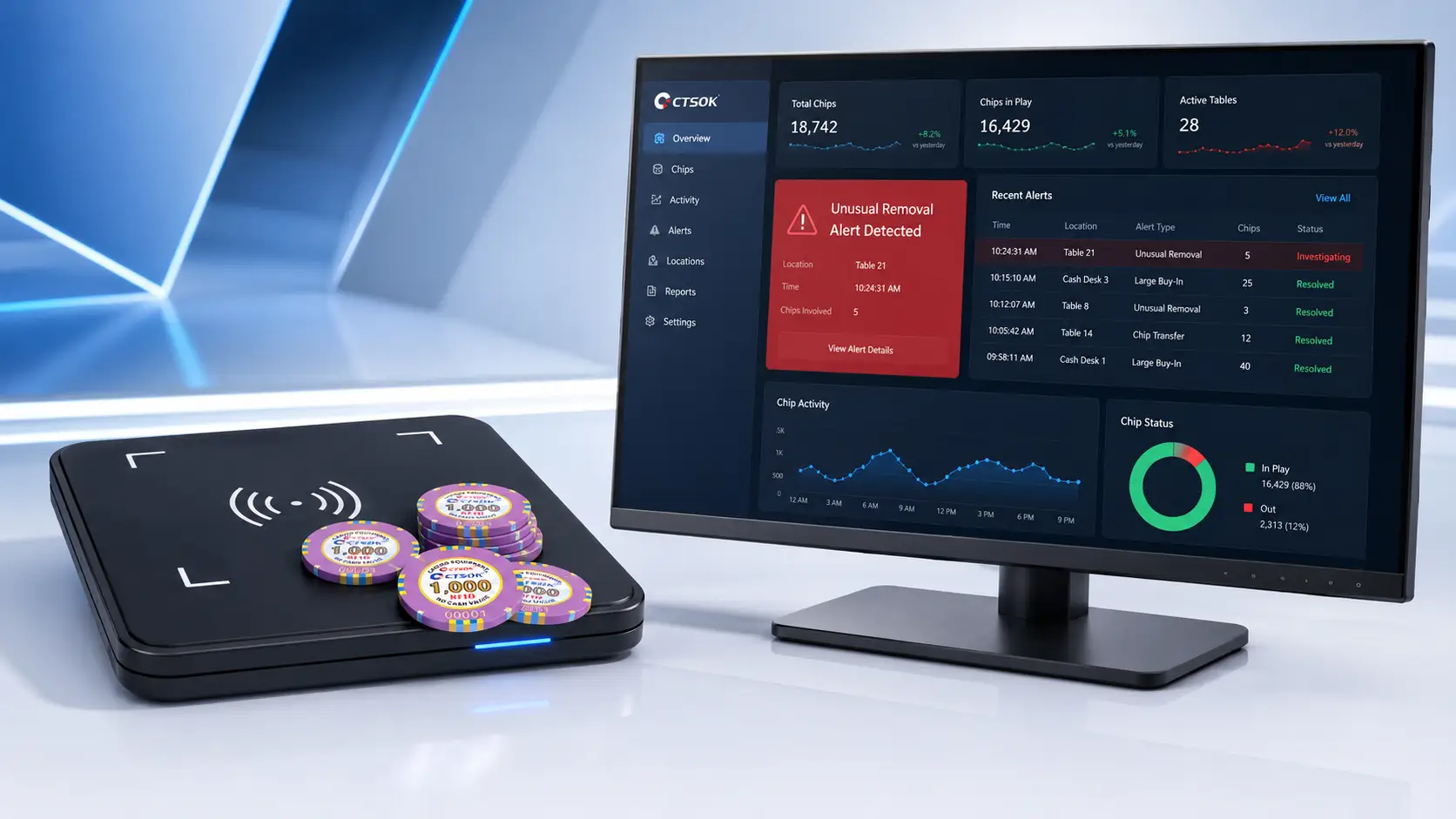

Explore CTSOK Casino Management System
Connect RFID chips, table games, player tracking, security monitoring, and real-time operation data in one integrated casino management platform.
View Casino Management System →
Casino table games are some of the busiest and most sensitive areas on a casino floor. Baccarat, blackjack, roulette, sic bo and poker-based games may have different rules, but they all share the same operational challenge: chips, tables, dealers, cage records, settlement results and security reviews must stay connected.
For players, a table game is part of the gaming experience.
For operators, it is also a live financial environment.
Every buy-in, payout, chip exchange, table fill, credit, shift change and settlement process creates information that needs to be checked. When these details are handled only through manual counting, paper records or separate systems, the review process can become slow and unclear.
An RFID-based casino management system helps operators manage casino table games with better visibility. It connects RFID chips, smart tables, chip trays, cage settlement, security alerts and compliance records into one management framework.
The goal is not to make the casino floor more complicated.
The goal is to make daily table game operations easier to verify, easier to reconcile and easier to control.
RFID technology allows casinos to identify chips through embedded radio-frequency tags. Each RFID casino chip can carry a unique electronic identity, helping the system recognize chips during table use, tray scanning, cage processing, settlement and inventory review.
When RFID chips are connected with smart tables, chip trays and casino management software, operators can better understand how chips move across the gaming floor. This is especially important for casino table games, where chips are constantly exchanged, paid out, collected, counted and reconciled.
The RFID CMS structure usually includes four key parts:
RFID casino chips contain embedded microchips that store unique identification data. Compared with traditional chips, RFID chips can support chip verification, asset recognition, inventory review and abnormal chip detection.
For casino table games, this means each chip is easier to identify during its movement from the cage to the table, from the table to players, and back into settlement or inventory.
Smart casino tables can work with RFID antennas and sensors to support chip recognition around the table area. These tables help operators review chip activity during buy-ins, betting, payouts, fills, credits and shift settlement.
In baccarat, blackjack and other table games, smart table integration helps reduce the gap between what happens on the table and what is reviewed in the back office.
RFID readers and smart chip trays capture chip information during table operation, cashier processing and settlement review. They help reduce repeated manual counting and provide a more reliable basis for chip balance confirmation.
For busy casino floors, fast tray scanning can make shift settlement clearer and less dependent on repeated manual recounting.
The software layer connects RFID chip data, table operation records, cage settlement, security alerts and compliance reports. It allows supervisors, cage staff and management teams to review table game activity through one centralized system.
Instead of only showing final results, the system helps explain how chip flow, settlement and operational records are connected.
In casino table games, chips move constantly.
They are issued from the cage, exchanged at tables, placed in betting areas, paid to winners, collected from losing bets, scanned in trays, counted during shift changes and reconciled during settlement.
If chip flow is not clearly recorded, operators may face several practical problems. A table balance may not match cage records. A high-value chip may appear in an unexpected area. A settlement difference may require repeated manual review. A suspicious movement may only be noticed after video playback.
RFID CMS helps reduce these gaps by giving each chip a digital identity and connecting chip movement with table and cage records.
For casino operators, this does not replace staff judgment. It gives supervisors, cage teams and management a clearer record to work with.
Settlement is one of the most important parts of casino table game management.
A table may operate smoothly during game play, but once the shift ends, the operator must confirm whether actual chip counts, table records and cage records are consistent.
Manual counting takes time, especially when multiple tables are operating at the same time. Different staff members may also record or confirm details in slightly different ways. When differences appear, the review process can become slow and difficult.
With RFID chips, smart chip trays and casino management software, settlement can become more structured. Chip data can be scanned, compared and recorded more efficiently. When a mismatch appears, the system can help identify where the issue needs to be reviewed.
For casino operators, this improves not only speed, but also confidence. Supervisors, cage staff and management teams can work from a more consistent set of information.
Surveillance cameras are important in every casino, but casino table games also require security control at the chip and transaction level.
Not every risk can be understood from video alone.
Fake chips, abnormal chip movement, unauthorized handling, over-limit or under-limit activities, and inconsistent table records may all require system-level review. RFID CMS adds another layer of control by connecting chip identity, table activity and management records.
When unusual chip movement or record differences appear, the system can help operators identify the issue earlier and review it with clearer supporting data.
This does not mean a system can remove every risk. The real value is that risk becomes easier to detect, easier to verify and easier to document.
Casino table games involve controlled procedures, staff permissions, player-related records, chip assets and financial settlement. For this reason, compliance is not only a final report. It depends on whether daily operations are recorded clearly enough for later review.
A casino management system can support role-based permissions, operation logs, daily and monthly settlement records, account review and audit-ready reports. These records help casinos build a clearer responsibility chain across table operations, cage processing and management review.
For operators, this is valuable because compliance pressure often appears after the event. When records are already structured and traceable, internal review and external audit become easier to handle.
Many casinos already use different tools for different tasks.
The cage may have its own records.
The table team may keep separate reports.
Surveillance may check video.
Finance may wait for exported data.
Each part may work independently, but the whole operation can still feel disconnected.
Casino table games require a more connected approach because the table is where chips, players, dealers, payouts, fills, credits and settlement all meet in real time.
An RFID CMS connects these areas into one management framework. RFID chips support chip recognition. Smart tables and chip trays support table-side scanning. Cage and settlement records can be linked with actual chip movement. Management software provides review, alerts, reports and compliance support.
This gives casino operators a clearer way to manage table games, not only after problems happen, but throughout daily operation.
CTSOK focuses on casino management systems, RFID casino chips, smart table management and AI-assisted casino operation solutions. Its RFID CMS is designed to help casino operators improve chip flow control, table settlement, security review, compliance management and operational transparency.
For casinos planning to upgrade the management of casino table games, the key is not only choosing better equipment. The more important goal is to connect chips, tables, cage settlement, security control and management reports into one reliable system.
With RFID-based casino management, operators can reduce manual blind spots, improve settlement consistency, strengthen chip security and build a clearer record trail for long-term casino operations.
Casino table games will continue to be one of the most important areas of live casino operations. A strong CMS helps operators manage this area with more confidence, clearer records and better control.
Interested in our products? Click the button below to book a demo or get more information