RFID casino chips may look similar from the outside, but the frequency system inside them can significantly affect how they are detected, where readers must be installed and which operational tasks they can support.
Two technologies are commonly discussed in RFID chip projects:
HF RFID, operating at 13.56 MHz
UHF RFID, generally operating within the 860–960 MHz range
The difference is not simply that UHF reads farther while HF reads closer. Casino chips are small, frequently stacked and placed next to other chips, table structures, electronic devices and human hands. These conditions make antenna design, chip orientation, reader placement and system calibration just as important as the nominal frequency.
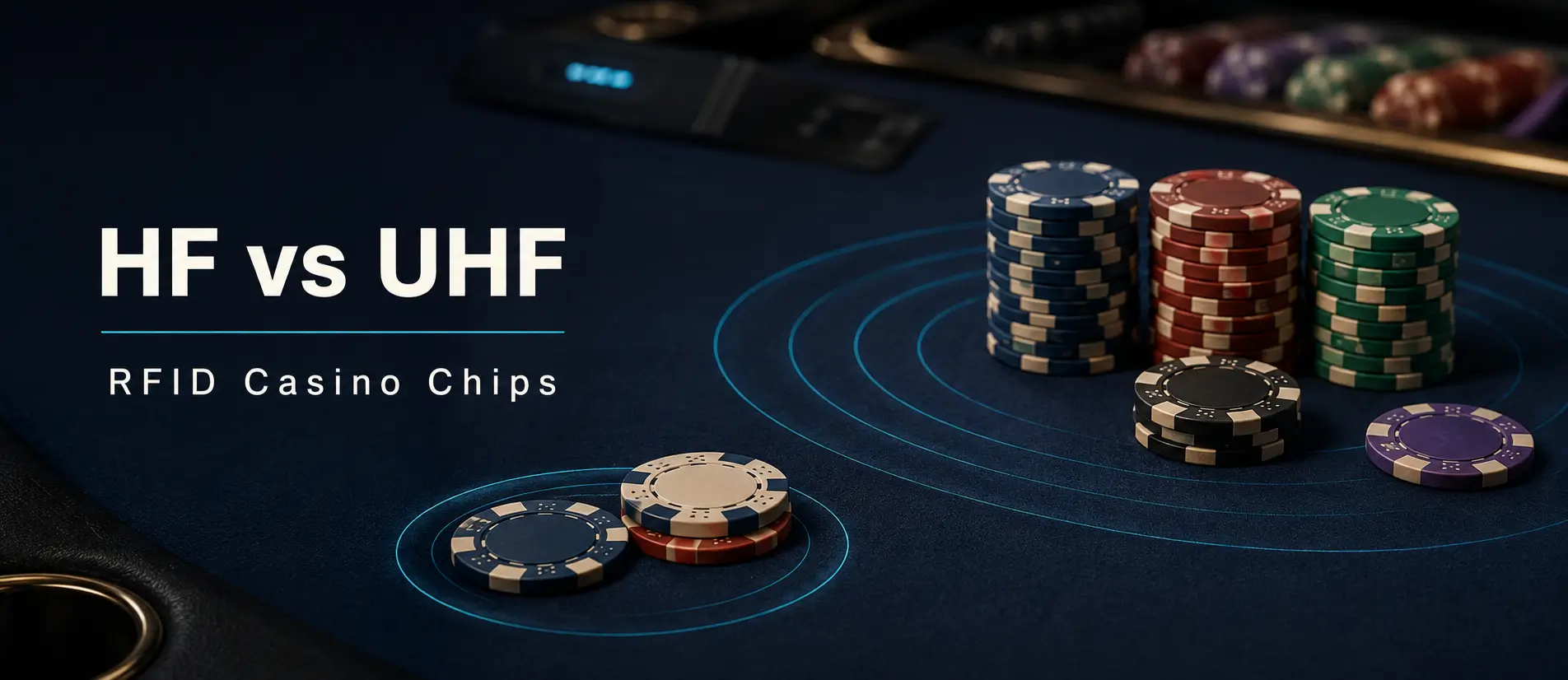
This article explains how HF and UHF RFID casino chips differ and why the appropriate choice depends on the intended reading zone.
HF stands for High Frequency. HF RFID systems operate at 13.56 MHz and usually communicate through inductive coupling between the reader antenna and the tag antenna.
ISO/IEC 14443 defines proximity contactless communication at 13.56 MHz, including radio-frequency power, signal interfaces, initialization, anti-collision and data transmission. ISO/IEC 15693 also operates at 13.56 MHz but is intended for vicinity-type RFID applications with different communication characteristics.
When HF technology is embedded into casino chips, the reader is generally designed around a controlled area, such as:
A defined betting position
A cashier inspection point
A chip tray section
A redemption or verification station
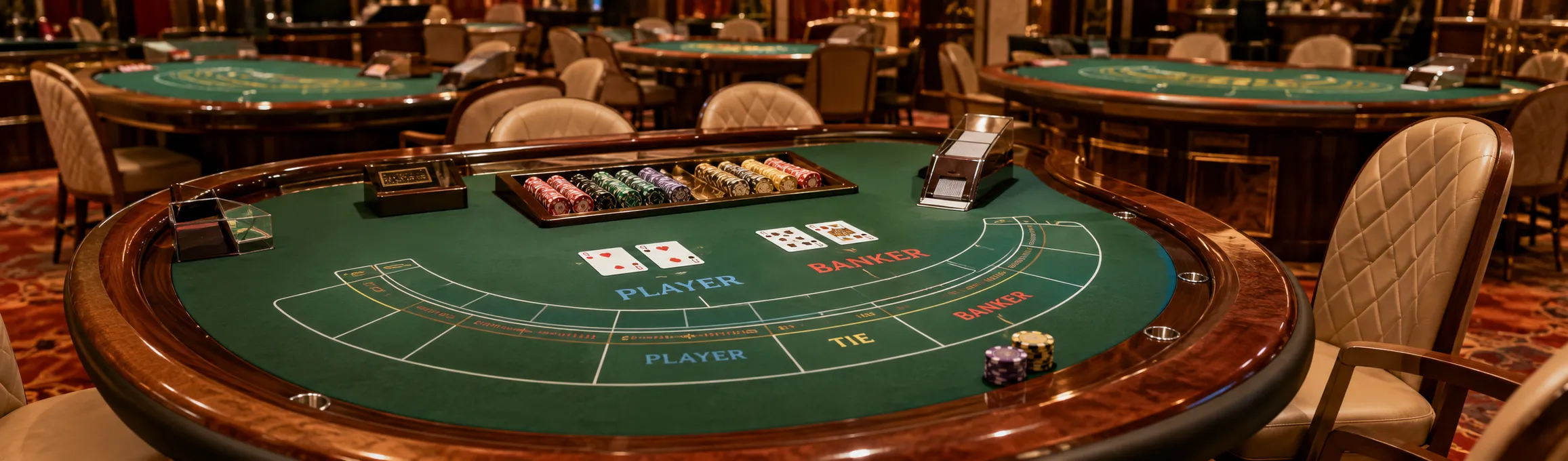
A designated area on an RFID baccarat table
Because the reading field can be confined to a relatively specific zone, HF can be useful when the system must distinguish chips placed within separate betting areas rather than detect every tagged object across a wider space.
However, “short range” does not automatically mean “more accurate.” The final result still depends on antenna geometry, reader power, chip construction, stack height and the surrounding table materials.
UHF stands for Ultra-High Frequency. Passive UHF RFID systems commonly operate between 860 MHz and 960 MHz, although the permitted channels and reader power vary by country or region.
ISO/IEC 18000-63 defines the air interface for passive UHF RFID devices operating within this frequency range. EPC Class 1 Generation 2, commonly called EPC Gen2, also defines communication between UHF readers and passive tags.
Unlike HF systems, passive UHF tags normally communicate through electromagnetic backscatter. This allows UHF systems to provide a larger potential interrogation zone and makes the technology widely applicable to item-level inventory and asset movement.
For casino operations, UHF may be considered for:
Bulk chip inventory
Chip storage rooms
Cage entry and exit points
Chip tray or trolley monitoring
Transfers between controlled operational areas
Large groups of chips passing through a defined checkpoint
The greater potential reading distance can be useful, but it also introduces additional control requirements. A reader may detect chips outside the intended area if antenna direction, reader power and shielding are not properly configured.
| Comparison | HF RFID | UHF RFID |
|---|---|---|
| Typical frequency | 13.56 MHz | 860–960 MHz |
| Coupling principle | Primarily inductive coupling | Electromagnetic backscatter |
| Typical deployment approach | Close, controlled reading zones | Wider interrogation zones |
| Common operational focus | Table positions and point verification | Inventory and movement monitoring |
| Sensitivity to surrounding conditions | Affected by antenna alignment and nearby conductive materials | More sensitive to orientation, detuning, reflections and surrounding materials |
| Regional frequency differences | 13.56 MHz is internationally standardized | Available frequencies and power limits vary by jurisdiction |
| Main implementation concern | Maintaining reliable detection inside a defined area | Preventing unintended reads outside the target area |
These are general engineering characteristics rather than guaranteed performance figures. A completed casino chip system must be tested with the actual chips, table materials, stack configurations and reader installation.
Neither frequency can be declared universally superior for every stack configuration.
Casino chips create an unusually demanding RFID environment. When multiple chips are stacked, their embedded antennas are positioned very close together. This can alter antenna tuning, reduce energy transfer and affect the response of individual tags.
The result depends on factors including:
Diameter and thickness of the casino chip
Antenna size and position inside the chip
Number of chips in the stack
Distance between the reader antenna and the stack
Whether the chips are aligned or scattered
Reader antenna shape and field distribution
Nearby metal, electronics and structural materials
Reader power and anti-collision configuration
HF can provide a controlled near-field reading area, which is useful for betting positions. UHF can support rapid inventory interrogation, but dense stacks and small tag antennas require careful engineering.
Claims such as “every UHF reader can identify hundreds of stacked casino chips instantly” or “HF always reads stacks more accurately” should therefore be treated cautiously unless they are supported by testing under a clearly defined configuration.
A smart table is not created simply by placing RFID tags inside chips. The complete reading environment must be engineered as one system.
A table-level deployment normally needs to consider:
Reader antenna placement
The antenna must cover the intended betting area without creating excessive overlap with neighbouring positions.
Physical table construction
Metal supports, decorative elements, cable routing and electronic equipment may influence the RF field. The table should therefore be prepared for RFID integration during its structural design.
Betting-zone separation
If several wagering positions are close together, the system must determine which antenna or logical zone is responsible for each detected chip.
Chip collision handling
Multiple tags may respond during the same reading cycle. The protocol, reader settings and application software must work together to process these responses.
Workflow integration
RFID data needs to be associated with the relevant game, table, position and operational event. Other equipment, including an electronic card shoe, may provide separate game-event data that must be synchronized at the application level.
This is why RFID performance should be evaluated on the finished table rather than based only on the chip or reader specification sheet.
HF is a practical option when the operational requirement is to detect chips at a specific position and reduce the possibility of reading chips outside that position.
Possible examples include:
Confirming chips placed in a defined betting zone
Checking the electronic identity of a chip at the cage
Reading chips placed in a dedicated tray compartment
Verifying promotional or cash-value chips at a controlled station
Associating a group of chips with a particular table event
The shorter and more controllable field can help with zone definition. Nevertheless, neighbouring antennas may still interfere if the table layout and reader timing are not properly designed.
HF therefore offers a useful engineering foundation for controlled reading, but it does not eliminate the need for site testing.
UHF is more attractive when the requirement is to detect tagged chips over a broader area or during movement through a checkpoint.
Possible applications include:
Counting chips inside a storage or cage area
Monitoring chip transfers between departments
Checking trays before and after transport
Detecting chips passing through a controlled doorway
Supporting periodic inventory reconciliation
These applications differ from determining exactly where a chip is located within a crowded betting layout. A UHF reader may identify the electronic identity of multiple chips, but the application still needs sufficient spatial control to determine whether each detection belongs to the intended operational event.
Directional antennas, shielding, controlled reader power and physical separation may therefore be required.
One of the most common misunderstandings is that a longer RFID reading range automatically provides better tracking.
Reading and locating are different functions.
A reader may successfully receive the identity of a chip without knowing its precise physical position. If several betting areas fall within the same RF field, the system must use antenna zoning, reader timing, signal analysis or additional software logic to associate the chip with the correct area.
For table games, a smaller and well-defined reading field may be more valuable than maximum distance. For cage inventory, detecting a larger number of chips within a controlled space may be more important.
The selection should therefore begin with the operational question:
Does the venue need to identify chips at a precise table position, or detect chips across a wider inventory and transfer area?
HF and UHF describe frequency ranges and communication methods. They do not, by themselves, guarantee that a casino chip is secure.
Security depends on the complete implementation, including:
The identifier stored on the RFID tag
Whether memory can be locked or rewritten
Authentication or cryptographic capabilities
Reader access control
Communication between readers and backend applications
Database permissions and audit records
Procedures for issuing, transferring and withdrawing chips
Methods used to detect copied or unauthorized identifiers
A globally unique or manufacturer-assigned tag identifier can help distinguish one chip from another, but a readable identifier should not automatically be treated as proof of authenticity. The system must validate the identifier against authorized records and apply the venue’s operational rules.
For a related operational example, see How RFID Casino Chips Distinguish Cash-Value and Promotional Chips.
HF RFID at 13.56 MHz is internationally recognized, although products must still comply with applicable local radio and product requirements.
UHF requires closer attention to the destination market. ISO/IEC 18000-63 covers RFID operation across 860–960 MHz, but individual jurisdictions do not necessarily authorize that entire range under identical conditions.
Regional rules may differ in:
Permitted channels
Maximum radiated power
Channel bandwidth
Frequency-hopping requirements
Listen-before-talk requirements
Duty-cycle restrictions
Equipment certification
A UHF reader configured for one market should not be assumed to be legally or technically suitable for another market without verification. Projects intended for several countries may require region-specific reader configurations or hardware versions.
RFID chip identification is one part of the table workflow. Other devices perform different functions.
For example:
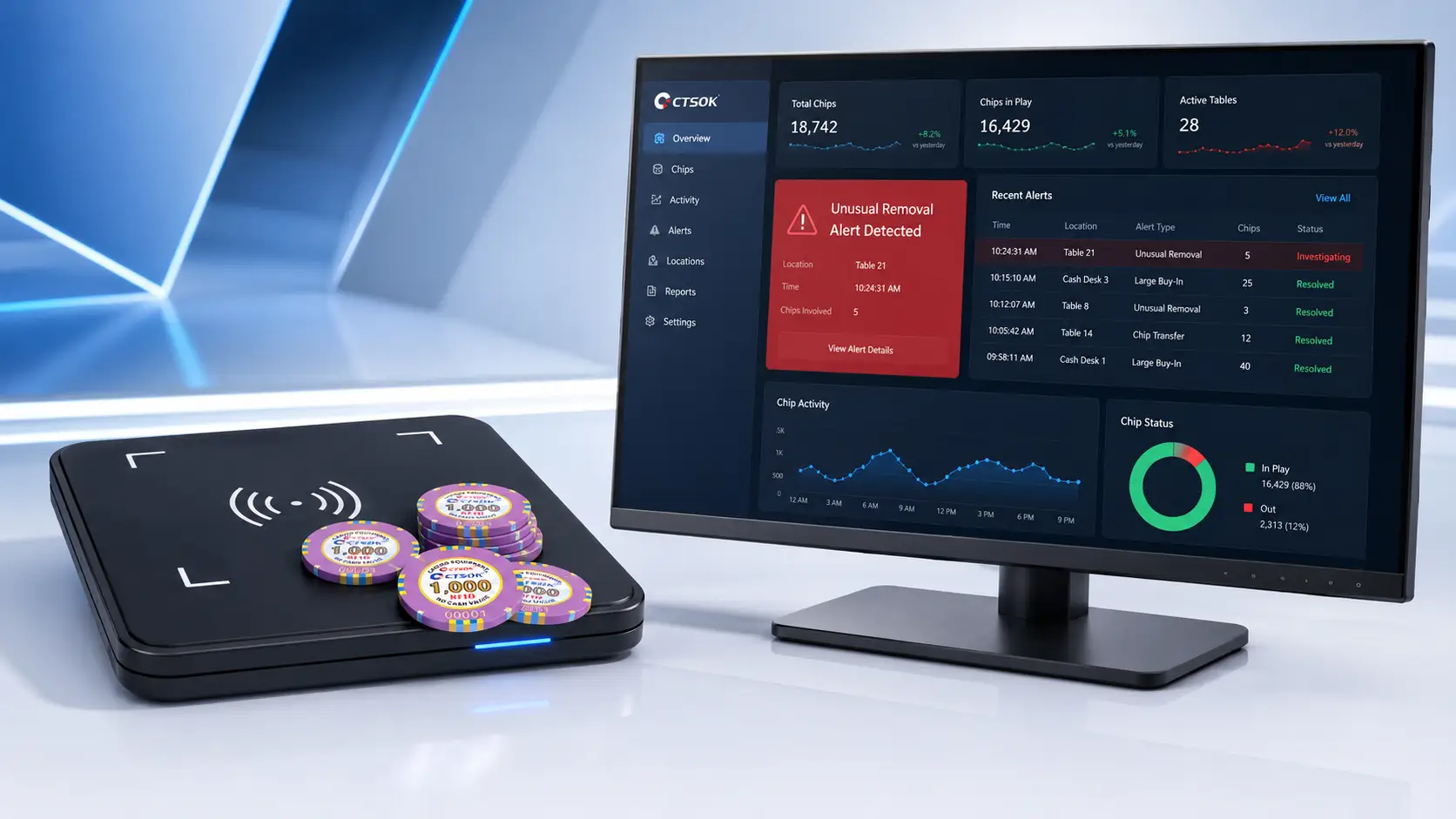
RFID antennas detect chip identities within configured reading areas.
Table applications associate detected chips with a game or betting position.
Card-handling equipment supports dealer workflow and game-event collection.
A baccarat roadmap display presents game history and roadmap information.
Backend applications retain operational records, permissions and exception events.
These devices do not automatically become a unified system merely because they are installed on the same table. Interfaces, timestamps, event definitions and error-handling rules must be designed so that data from different devices can be reconciled correctly.
Operators planning an integrated deployment should therefore evaluate the complete casino RFID and AI equipment ecosystem, rather than selecting each component only by its individual specification.
A practical selection process should begin with the reading scenario.
Chips must be identified within individual table zones.
Short-range point verification is the main requirement.
Limiting detection beyond the intended area is important.
The table can accommodate purpose-designed near-field antennas.
The system will be calibrated for specific chip stacks and layouts.
Bulk inventory is the primary objective.
Chips need to be detected during transfers.
A wider reading zone is operationally useful.
The installation can use directional antennas or shielding.
Regional spectrum requirements have been verified.
A venue needs precise table-level reading as well as broader cage or inventory monitoring. In this case, different RFID technologies may serve different operational layers.
However, a hybrid design increases hardware, integration and maintenance complexity. It should only be adopted when the operational benefit justifies that additional complexity.
Before selecting either HF or UHF, the supplier and operator should perform application-specific tests using the actual equipment.
The test plan should include:
Single-chip detection
Multiple-chip and full-stack detection
Mixed-denomination stacks
Different chip orientations
Chips positioned at the edge of a reading zone
Adjacent betting-zone interference
Reader recovery after chips are added or removed
Detection near displays, card shoes and table electronics
Maximum expected stack height
False reads outside the intended zone
Performance during realistic dealer and player movements
Reader behaviour after power or network interruption
The results should document the tested configuration. A statement such as “supports simultaneous reading” is incomplete unless the test also identifies the number of chips, antenna arrangement, distance, stack pattern and acceptance criteria.
HF and UHF RFID casino chips are designed around different radio-frequency characteristics.
HF at 13.56 MHz is well suited to controlled, close-range reading zones and can be a practical choice for table positions and verification stations. UHF in the 860–960 MHz range provides a larger potential interrogation area and may be better suited to inventory, cage and chip-transfer applications.
Neither frequency guarantees successful table performance on its own. The correct choice depends on antenna design, chip construction, stack density, table materials, reader configuration, regional radio rules and the operational event that the system needs to record.
For casino operators, the most reliable approach is to define each reading zone first, select the appropriate RFID architecture second and then validate the completed installation under realistic operating conditions.
This article references technical standards and public materials published by the International Organization for Standardization — ISO/IEC 14443-2, ISO/IEC 18000-63:2021, the GS1 EPC UHF Gen2 Air Interface Protocol, and Gaming Laboratories International Standards. The ISO/IEC and GS1 documents were used to verify the operating frequencies, communication principles, and air-interface standards of HF and UHF RFID. GLI materials were referenced to clarify that gaming equipment and systems must be independently evaluated according to the applicable requirements of the target jurisdiction. Reference to these standards does not imply that any product has automatically received regulatory approval or GLI certification.
Interested in our products? Click the button below to book a demo or get more information