
In an increasingly competitive global operating environment, casino operators are facing unprecedented challenges. While macro gross gaming revenue (GGR) figures often capture media attention, for floor managers and CFOs, the real challenge lies in the "intangible losses" hidden in the folds of financial statements.
According to internal industry data estimates, traditional casinos without intelligent upgrades may incur hidden costs equivalent to 3% to 5% of total annual profits due to chip loss, internal collusion, manual inventory errors, and counterfeit infiltration. For a venue with annual revenues of hundreds of millions of dollars, this means tens of millions of dollars in net profit evaporating silently.
How to accurately monitor the flow of every asset? How to eliminate management blind spots caused by human operation? The answer lies in the integration of physical assets and digital technology — RFID (Radio Frequency Identification) digital tracking technology is becoming the core defense line for modern casinos to plug profit loopholes.
Before introducing RFID technology, we must first identify the "root causes" of the traditional management model. Why can't intensive surveillance cameras and manual audits completely eradicate asset loss?
Traditional chip anti-counterfeiting technologies (such as special materials and microprinting) are a form of "passive defense". Such anti-counterfeiting designs are advanced at the time of production, but with the iteration of underground manufacturing technology, high-quality counterfeit chips can replicate over 95% of the physical characteristics of genuine ones. Once these counterfeits enter table circulation, they result in direct property losses for casinos as long as they can be exchanged for cash. The traditional model cannot real-time verify whether "this specific" chip is a legally authorized asset of the system.
Humans are the core of operations, but also a source of risk. Internal collusion is the most elusive loss point in the industry. On a busy gaming floor, subtle actions between dealers and specific players, or minor numerical adjustments during financial reconciliation, often take weeks or even months of audit retrospection to detect without digital tagging — by which time the funds have almost always been lost.
Many venues still rely on paper-based or semi-automated reconciliation processes. Chips undergo multiple manual counts as they move from the cage to the tables and then to the settlement center. Each count represents a potential error point. When the final data fails to reconcile, managers struggle to determine: Is this a calculation error? Or did someone take chips midway? Such "data fractures" lead to ambiguity in accountability.
Chips are taken out of the venue by customers, circulated across different casinos, or held by customers for long periods. For traditional venues, this means a portion of the "issued chips" is out of monitoring. Without an accurate count of the exact number of chips in circulation across the entire venue, the balance between financial budgeting and cash reserves will be skewed.
The core solution to the above problems is to endow every chip with the ability to "speak proactively". The RFID digital tracking solution developed by CTSOK essentially transforms each chip into a digital terminal with a globally unique ID.
Unlike physical anti-counterfeiting, the electronic chip embedded in RFID chips has an unmodifiable globally unique identifier (UID). When chips are issued, the system establishes a "strong binding" between the ID and its corresponding denomination, batch, issuance date and other information in the background database.
Key Encryption: CTSOK adopts multiple encryption protocols to ensure that data transmission during reading and writing is not intercepted or simulated.
Blacklist Mechanism: Once an abnormal batch of chips is detected or declared invalid, the system can immediately add its UID to the blacklist, rendering it ineffective in all table sensing areas.
Traditional RFID tags often face the technical bottleneck of "stack reading". However, in a casino environment, chips usually exist in stacks of dozens.
High Concurrent Reading: Through optimized antenna design and algorithms, CTSOK's readers can identify hundreds of chips in the sensing area simultaneously within 1 second.
Dynamic Tracking: When chips move from the chip tray to the betting area, or from the table back to the cage, the system captures every coordinate change. This real-time performance completely eliminates delays in data updates, allowing management to grasp the "digital map" of venue-wide assets at any time.
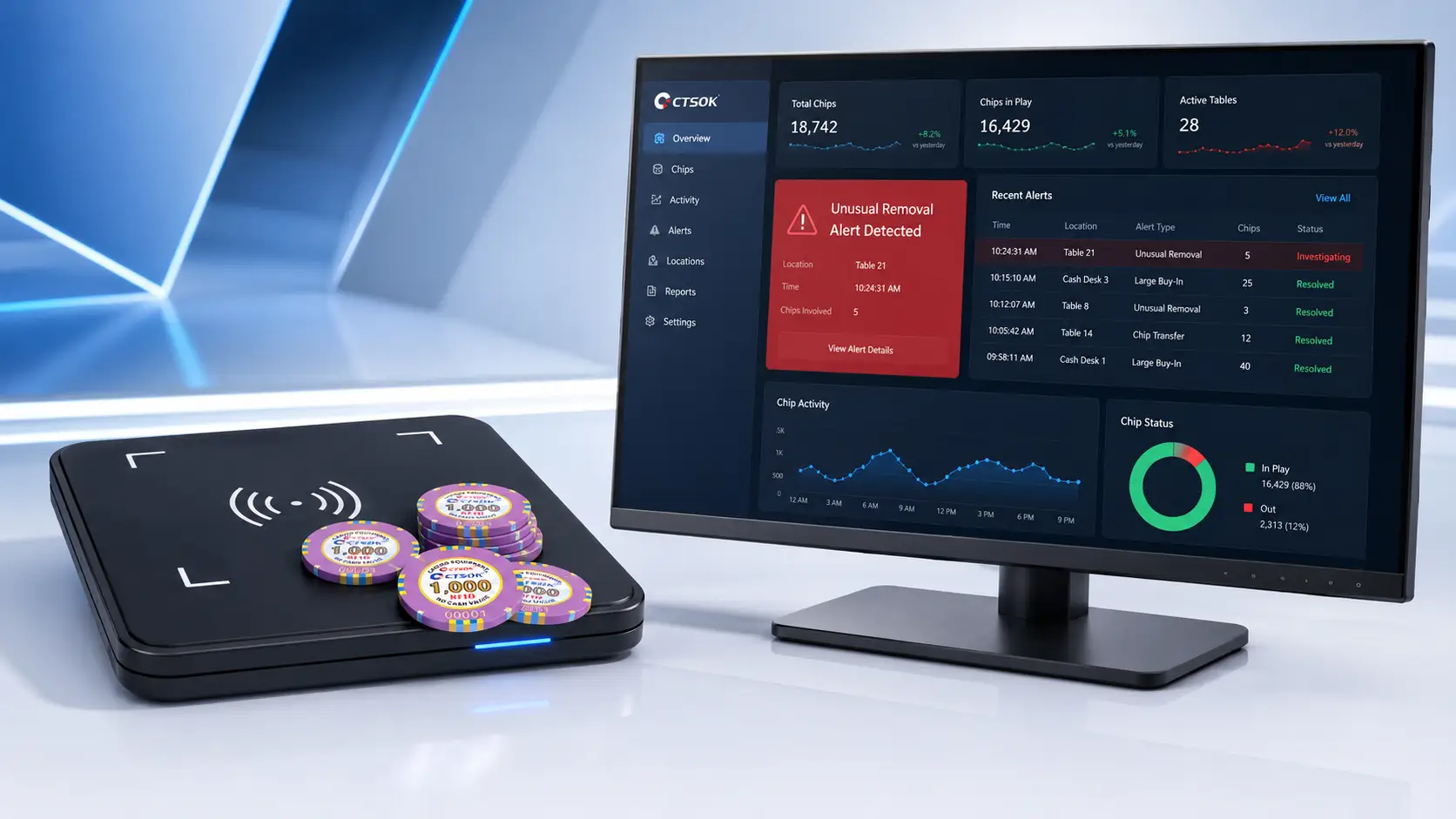
Data itself is cold; only through AI analysis can it be transformed into a basis for decision-making. The massive data flow generated by RFID technology is instantly imported into our AI Super Management Center. AI establishes an "operational baseline" based on historical data. Once the chip flow speed, payout rate, or inventory change curve of a table deviates from the norm, the system immediately issues a red dot alert to prompt monitoring personnel to intervene. This is the upgrade from "blind inspections" to "precision defense".
The plugging of profit loopholes by the RFID system is reflected not only in "anti-theft", but more importantly in the value brought by the improvement of "operational efficiency".
During shift changes or venue closing, traditional manual inventory may take 15 to 20 minutes. This period is a vulnerability for security management, as personnel from multiple departments are frequently in contact with large cash assets.
RFID Solution: Dealers only need to push the chip tray, and the system instantly completes statistics and generates digital reports. This "transparent reconciliation" allows the settlement process to be completed in an instant under the watchful eyes of all and digital monitoring, eliminating the possibility of fraud using the time difference of manual counting.
The transportation of chips between the cage and gaming tables is a high-risk link for asset loss.
Digital Escorting: Through mobile reading devices, the system can record who took how many chips of each denomination from which cage at what time, and whether these chips accurately reached the target table. Once the path or amount is inconsistent, the system will reject the posting of the transfer, forming a strong technical deterrent.

In the management practice of casinos, nothing troubles operators more than "internal collusion". Illegal technical coordination between dealers and players, or between supervisors and frontline employees, is often hidden beneath seemingly normal revenue fluctuations. Traditional closed-circuit television (CCTV) can record images, but cannot real-time "understand" the economic anomalies behind the data.
The introduction of RFID technology endows the bet amount and payout amount of each hand with digital attributes. CTSOK's AI system builds a dynamic "expected return model" for each table.
Deviation Analysis: If the payout frequency of a table in a specific period, or the payout flow of high-denomination chips, continuously deviates from the mathematical expectation (House Edge), the system will automatically mark this period.
Precision Retrospection: Monitoring personnel no longer need to blindly sift through 24 hours of video footage, but can directly jump to the "digital anomaly points" marked by the system to view personnel actions at that time. This "data finds people" model leaves hidden collusive behavior with nowhere to hide.
In a busy environment, criminals may take advantage of the dealer's visual blind spots to "smuggle" or replace chips.
Real-Time Inventory Verification: The RFID system scans the table chip tray every second. If chips without scanning records suddenly appear in the betting area (air drop), or the total amount in the chip tray decreases for no reason without any payout (chip theft), the system will pop up an alarm instantly and display a flashing red frame on the management terminal screen. This dual physical and digital lock shortens the criminal time window to zero.
The threat of counterfeit chips lies in their "concealment" and "scalability". Once traditional physical anti-counterfeiting is breached, the venue is like a city without gates. RFID digital tracking technology, on the other hand, builds an invisible "digital firewall" around every chip.
Every RFID chip entering circulation in the casino must have a "legal identity" in the central database.
Offline Anti-Counterfeiting: When illegal chips enter the table sensing area, even if they have a perfect appearance and consistent weight, the system will immediately lock the table as long as they do not have a legal ID connected to the system or the ID is in an "unactivated" state.
Off-Site Early Warning: RFID sensors are installed not only on tables, but also at main entrances and exits and cage thresholds. If someone attempts to enter or exit the venue with unauthorized high-denomination chips, the system can capture the signal immediately, achieving "defending the enemy outside the gate".
Criminals sometimes mix chips from other venues or obsolete invalid chips into circulation. The RFID system has a powerful batch management function that can automatically identify assets that do not belong to the venue or have been marked as "recycled". This not only ensures asset security, but also prevents illegal funds from being laundered through the gaming tables.
For the decision-making level, RFID is not only a security tool, but also a financial optimization tool. We can calculate the return from plugging "profit loopholes" through a specific financial model.
Assume a casino with 80 gaming tables, with an average annual turnover of $5 million per table.
Traditional Losses: Assume the total loss rate including counterfeiting, internal theft, and manual reconciliation errors is 1%. This means a direct annual profit loss of $4 million.
RFID Optimization: After the implementation of digital tracking, the above losses can be reduced by more than 80%. This single item alone can directly "recover" $3.2 million in net profit for the venue every year.
Under the traditional model, to cope with the risk of "unreconciled accounts", casinos often need to reserve more spare chips than the actual demand.
Precision Inventory Management: The RFID system can accurately report the real-time turnover rate of chips of each denomination. Managers can optimize the chip inventory structure and reduce idle funds accordingly. This improvement in capital liquidity has extremely high strategic value for the financial operation of large groups.
Many operators worry that system upgrades will affect existing business. CTSOK's implementation strategy emphasizes "seamless access".
Phase 1: Infrastructure Digitalization. Quickly install table sensors and background servers during shift changes or downtime.
Phase 2: Gradual Asset Replacement. Gradually deploy RFID chips during the normal chip cleaning or replacement cycle. The system supports the transitional "mixed operation" of traditional and digital chips to ensure no impact on customer experience.
Digitalization does not mean replacing humans, but empowering them. Our training enables supervisors to learn how to read system reports and use early warning information for precise inspections. When employees realize that every chip is under "monitoring", the original criminal motives will be greatly reduced due to technical deterrence, achieving the fundamental management goal of "addressing the root cause".
Asset security occurs not only on the gaming tables, but also in every "vacuum zone" of asset transfer. The most vulnerable moments of the traditional management model are often the process of chip transfer between different departments.
The cage is the cash and chip hub of the entire casino. In the traditional process, cage staff need to frequently count large amounts of chips for warehousing and outbound operations.
Paperless Allocation: Through RFID long-range antennas installed at high places or counters, entire cases of chips can be scanned for warehousing without unpacking. The system automatically compares the data of the sending end and the receiving end, and the transfer process will be frozen immediately if there is a quantity discrepancy. This completely eliminates the possibility of "midway loss".
Real-Time Inventory Dashboard: The screen in the general manager's office can display the real-time distribution ratio of chips across the entire venue. This transparency allows managers to instantly identify which tables have excessive asset backlog and which areas have potential risks.
In many venues, chip management for intermediaries or agents (such as chip conversion and laundering) is a link prone to loopholes.
Source Tracking: RFID technology can mark that a specific batch of chips belongs to a certain agent or a certain VIP area. This can effectively prevent chip arbitrage between different areas and ensure that every commission settlement is based on accurate digital flow, rather than vague accounts from manual records.

The maturity of RFID technology marks the official entry of casinos into the "era of proactive defense". In the next 3 to 5 years, this technology will integrate with more intelligent sensors.
Future management systems will combine RFID chip data with facial recognition and body movement recognition technologies.
Behavior Correlation Analysis: When AI finds that a player has made abnormal denomination chip exchanges at multiple tables in a short time, and RFID data shows that these chips come from abnormal channels, the system will notify the security team before the player reaches the next table.
Preventive Risk Control: AI will no longer only alarm after an incident occurs, but predict possible cheating or internal violations based on abnormal patterns of chip flow, truly achieving prevention before the event.
With the popularization of technology, cross-venue anti-counterfeiting data sharing may emerge in the future. When an RFID chip marked as lost or stolen in Casino A attempts to be cashed in Casino B, the global networked system will trigger a cross-regional alarm, leaving criminals with nowhere to hide and fundamentally undermining the circulation value of illegal chips.
Returning to the original question: How to plug profit loopholes?
In the era of information asymmetry, casino managers could only rely on strict rules and high-pressure monitoring methods. But in the digital age, technology provides us with a more elegant, precise and humanized solution. RFID digital tracking technology is not just about catching a thief or finding a cheating dealer; its core value lies in building an operational system based on data and trust.
For any casino aiming for long-term development, enduring annual losses of millions of dollars and relying on inefficient manual reconciliation is no longer a sustainable business model. CTSOK's solution transforms every chip into a sentinel guarding profits and every management blind spot into a transparent digital window.
This digital transformation is a race for efficiency and a race for security levels. In the future industry structure, only those operators who can master the flow of every asset of their own can laugh last in the fierce market competition.
Q: Will RFID chips be interfered by mobile phones or electronic devices in the venue? A: CTSOK adopts a proprietary frequency band filtering algorithm that can effectively isolate various wireless communication interferences, ensuring a reading rate of up to 99.99% in complex electromagnetic environments.
Q: Is the chip inside the chip easy to damage? A: Our chips are encapsulated in the center of shock-resistant reinforced resin, passing rigorous 2-meter drop tests and tens of thousands of shuffler wear tests, with an average service life of more than 5 years.
Q: Will the system installation require a long downtime? A: No. We adopt modular deployment, and the equipment installation and testing of a single table can be completed within 30 minutes, which can be fully realized through seamless upgrades during off-peak hours.
Q: How to ensure data security and prevent hacker intrusion? A: The system adopts bank-level national encryption algorithms for end-to-end encryption, and the database supports local deployment and offline operation, ensuring that all core operational data is only in the hands of the venue.
Interested in our products? Click the button below to book a demo or get more information