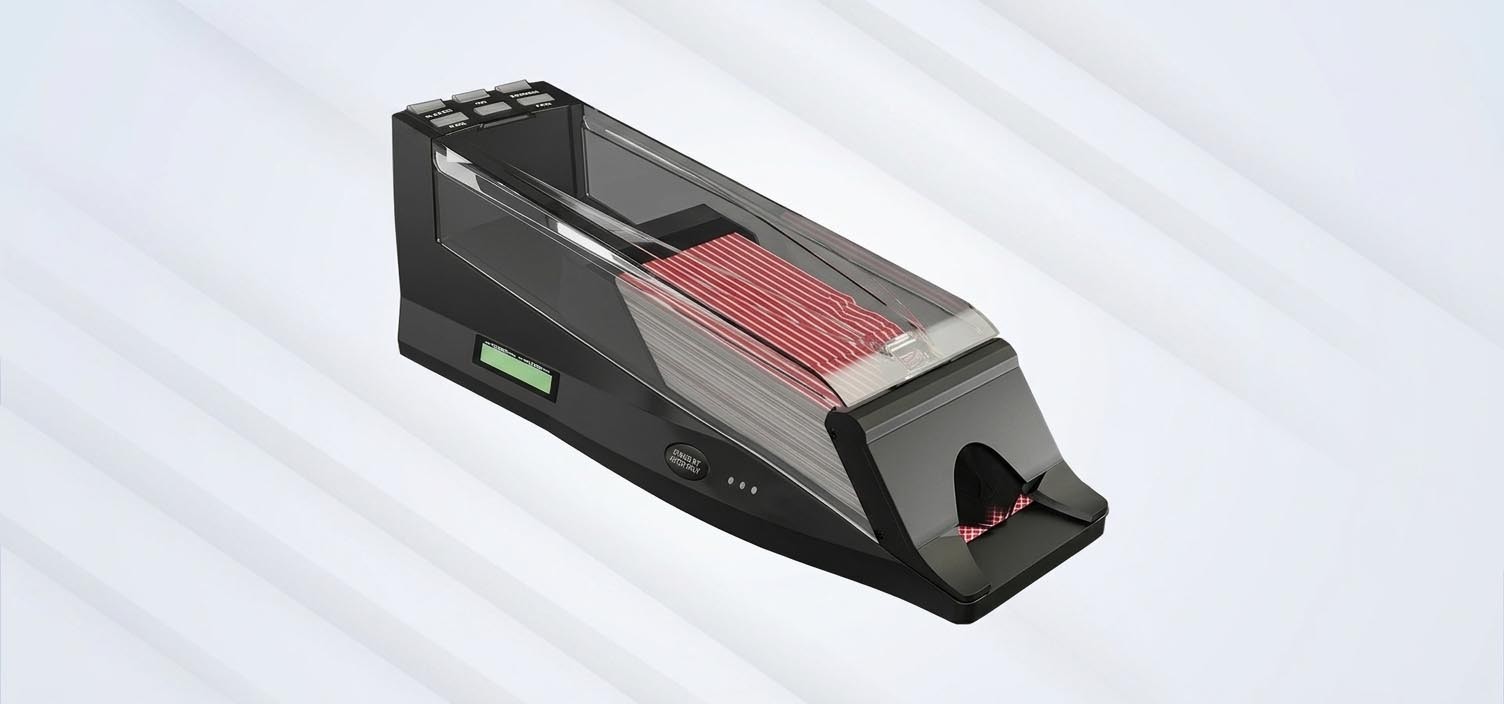
For decades, the traditional card shoe has been a standard piece of equipment on baccarat and blackjack tables. Its purpose is simple: hold multiple decks of cards and allow dealers to draw cards smoothly throughout the game.
As casino operations become increasingly focused on accuracy, consistency, and real-time table monitoring, a new generation of equipment has emerged—the electronic card shoe.
Unlike a traditional card shoe, an electronic card shoe does more than store and dispense cards. It can identify cards as they are dealt, record game information, communicate with external systems, and provide immediate visual confirmation of game outcomes.
Today, electronic card shoes are commonly found in baccarat pits across Asia and are gradually becoming standard equipment in many high-volume gaming environments.
An electronic card shoe is a card dealing device equipped with card recognition technology.
As cards are removed from the shoe, built-in sensors automatically identify each card and process the information in real time.
Depending on the system configuration, the electronic shoe may also:
Display Banker, Player, or Tie results
Send data to roadmap displays
Connect with table management systems
Record game histories
Support surveillance reviews
Generate operational reports
Most baccarat electronic shoes are designed for eight decks of cards, matching the requirements of standard baccarat operations.
From a dealer's perspective, gameplay remains largely unchanged. The difference is that every card dealt can now be electronically recognized and recorded.
Although designs vary between manufacturers, most electronic card shoes follow the same basic workflow.
After shuffling, cards are placed into the shoe just as they would be in a traditional baccarat setup.
Most electronic baccarat shoes are designed to accommodate eight decks.
When the dealer removes a card, it passes through a card recognition zone located near the dealing outlet.
Optical sensors capture card information instantly.
The system identifies:
Card rank
Card suit
Card sequence
The information is processed within milliseconds.
For baccarat applications, the system automatically calculates hand values and determines whether the result is:
Banker
Player
Tie
The information can then be sent to connected systems, including:
Baccarat roadmap displays
Table monitoring platforms
Data reporting terminals
This entire process occurs in real time without interrupting the normal dealing procedure.
While electronic shoes may appear simple from the outside, several technologies work together internally.
The recognition module is the most important component.
High-speed sensors capture images of every card passing through the dealing channel.
The software compares these images against stored templates to identify the exact card.
More advanced systems use multiple recognition points to improve reliability and reduce reading errors.
A built-in processor receives card information and performs calculations.
This allows the shoe to determine game outcomes immediately after cards are dealt.
Many electronic shoes include LED indicators or integrated displays.
These can show:
Banker wins
Player wins
Tie outcomes
System alerts
Error notifications
Visual confirmation helps reduce misunderstandings during busy table operations.
Modern electronic shoes are often equipped with:
USB connections
Serial ports
Ethernet interfaces
These connections allow integration with other gaming systems.
Although both devices perform the same basic dealing function, their capabilities are very different.
| Feature | Traditional Card Shoe | Electronic Card Shoe |
|---|---|---|
| Card Storage | Yes | Yes |
| Card Recognition | No | Yes |
| Automatic Result Display | No | Yes |
| Data Recording | No | Yes |
| System Connectivity | No | Yes |
| Real-Time Reporting | No | Yes |
Traditional shoes remain widely used, particularly in smaller gaming operations.
However, casinos seeking greater operational visibility often prefer electronic alternatives because they provide additional information beyond the dealing process itself.
Electronic card shoes are most commonly associated with baccarat.
There are several reasons for this.
First, baccarat tables often run continuously for long periods and can generate a high number of hands per hour.
Second, baccarat operations frequently use roadmap displays that require accurate game result tracking.
Third, many premium baccarat areas emphasize procedural consistency and detailed table records.
Electronic shoes help support these requirements by automating part of the information collection process.
As a result, baccarat remains the primary application for electronic card shoe technology worldwide.
One of the most common uses of electronic card shoes is roadmap automation.
Traditionally, game results were entered manually into roadmap systems.
With an electronic shoe, outcomes can be transmitted automatically after each hand.
Benefits include:
Faster updates
Reduced manual input
Consistent result recording
Simplified table supervision
For casinos operating multiple baccarat tables simultaneously, automated roadmap integration can significantly reduce routine administrative work.
Many modern electronic shoes support integration with external casino technologies.
Depending on the manufacturer and software platform, electronic shoe data may be shared with:
Table management systems
Gaming analytics platforms
Surveillance review systems
RFID chip tracking systems
Casino management software
This allows operators to combine table game information with broader operational reporting tools.
Rather than functioning as isolated equipment, electronic card shoes can become part of a connected gaming environment.
Before selecting a system, operators should evaluate several factors.
Most baccarat operations require support for eight decks.
Card reading performance is one of the most important specifications.
The shoe should communicate smoothly with existing displays and management systems.
Gaming equipment often operates continuously and must withstand intensive daily use.
Replacement parts, software updates, and maintenance services should be considered before deployment.
Electronic card shoes are no longer limited to basic card dispensing.
Modern systems combine dealing functionality with card recognition, automated result tracking, and system integration capabilities.
For baccarat operators, this technology provides a practical way to improve information accuracy while reducing manual processes around table management.
As gaming equipment continues to evolve, electronic card shoes are becoming an increasingly common component of contemporary table game operations.
An electronic baccarat shoe is a card dealing device equipped with card recognition technology that can identify cards, calculate results, and communicate with external systems.
Most baccarat electronic shoes are designed for eight decks of cards.
Yes. Many systems support direct integration with baccarat roadmap displays and scoreboards.
No. Automatic shufflers shuffle cards, while electronic card shoes identify and track cards during the dealing process.
Yes. Traditional card shoes remain common, although electronic shoes are increasingly used in high-volume baccarat environments.
Interested in our products? Click the button below to book a demo or get more information