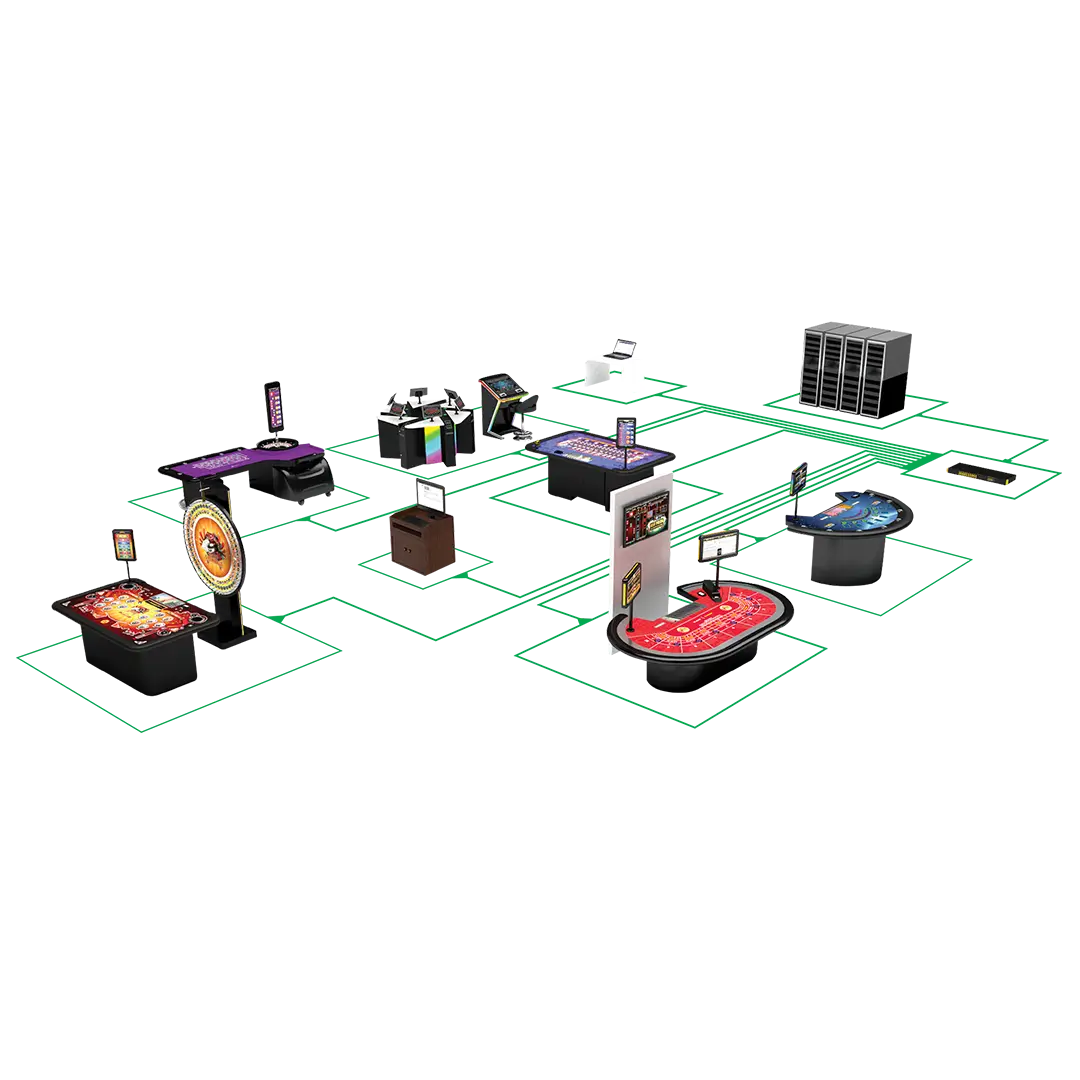

Walk through a casino table-games area and the differences are immediately visible. Blackjack tables usually form a compact semicircle. Baccarat tables may be wider, deeper and more symmetrical. Roulette tables stretch lengthwise, with the wheel occupying an entire section beside the betting layout.
These shapes are not simply decorative choices.
A commercial gaming table is built around a repeating sequence of actions: players place chips, the dealer manages cards or equipment, winning positions are identified, payouts are made, losing wagers are collected and the table is prepared for the next round.
Because those actions are different in baccarat, blackjack and roulette, the physical tables are different too.
The shape determines how far the dealer must reach, how many positions can remain visible, where chips are placed and which equipment can be installed without interfering with the game. The printed layout then turns that physical surface into an operational interface.
Before considering wood finishes, felt colors or branding, table designers need to understand what moves across the surface.
That may include:
Playing cards
Casino chips
A roulette marker
A card shoe
A discard holder
A chip tray
A drop box
A display terminal
Table identification equipment
Optional electronic or RFID components
The most important areas must remain within a practical working distance. If a table is too deep, the dealer may struggle to collect cards or settle wagers at the far edge. If it is too narrow, betting positions can become crowded. If accessories are placed incorrectly, they may block the layout or interrupt the dealer’s normal movement.
This is why the best shape for one game may be unsuitable for another.
A baccarat round revolves around a small group of main outcomes, most commonly Player, Banker and Tie. Depending on the rules used by the casino, the layout may also include pairs, side bets or game-specific wagering areas.
Traditional full-size baccarat tables can be relatively large because they may support more participants and a different dealing format. Mini baccarat tables are more compact and are generally structured around a single dealer position.
The oval or extended curved shape serves several purposes:
It provides a continuous player-facing edge.
It distributes repeated betting areas across the table.
It keeps Player, Banker and Tie positions visually separated.
It gives the dealer space for the card shoe, discard area and chip handling.
It can accommodate display or table-identification equipment.
A current CTS baccarat table reference configuration measures 2440 × 1220 mm. This is a product specification rather than a universal baccarat-table standard; final dimensions can be adjusted according to the table format, number of positions and equipment configuration.
The extended curved edge distributes player positions while keeping the central betting and dealer areas visible.
The printed layout is just as important as the table body. Repeated wagering zones must line up naturally with the intended seats. If side bets are added later without enough space, the layout may become difficult to read and chips placed in adjacent areas may appear too close together.
For that reason, the rules and betting options should be confirmed before the table cloth enters production.
Blackjack creates a different movement pattern.
Each player position can produce its own decisions and chip movements during the same round. One player may stand, another may take additional cards, while another may split or double down. Insurance and optional side bets can add more designated areas around each seat.
The familiar semicircular blackjack table places the dealer near the center of the straight side while arranging players around the curved edge. This geometry brings the betting positions toward a common working point.
It allows the dealer to:
Deal cards across several positions
Observe each player’s hand
Reach the primary betting areas
Collect losing wagers
Pay winning hands
Access the chip tray and card equipment
Keep completed cards separate from the active playing area
Commercial blackjack tables are often configured for five to seven player positions, although the final number can be customized. More seats do not automatically make a table better. Increasing capacity without adjusting the width and curvature can reduce the space available for cards, chips and separate betting actions.The semicircular form keeps multiple independent hands within the dealer’s working area.
Gaming-equipment regulations also demonstrate how closely the physical table is connected to the rules. Massachusetts Gaming Commission equipment regulations, for example, require blackjack layouts to contain designated betting areas for each player position. Additional wagers require their own marked areas, while dealer-side equipment can include a securely attached discard rack.
The exact requirements differ between jurisdictions and game variations, but the underlying principle remains consistent: the table must physically support every wager and procedure offered on it.
Roulette has the most visibly asymmetrical structure of the three.
One part of the table holds the wheel. The other holds the betting layout. These areas are related, but they perform different functions and require different kinds of space.
A single-zero roulette layout contains the numbers 0 through 36. It also includes outside betting areas for groups such as red or black, odd or even, columns and dozens. Some European-style layouts add a racetrack section for announced or sector-based bets.
The dealer needs access to both the wheel and the betting surface. The table must also leave room for accessories such as:
The roulette marker
Chip storage
A collection brush
A drop box
Dealer-side storage
A result display
A wheel support structure
Internal cable routing
This explains the long roulette-table profile. A compact semicircle would not provide enough separation between the wheel and the full number grid.
Roulette tables combine a mechanical wheel area with a separate, extended betting surface.
The CTS RT-Single product provides a reference size of 2750 × 1500 × 780 mm and a listed reference weight of 150 kg. Its wheel can be configured according to the project, with 30-inch and 32-inch options listed for the series.
Again, these figures describe an actual product configuration—not a worldwide rule for every roulette table. The final dimensions depend on the wheel, layout format, table body, accessories and room design.
Roulette also requires careful installation. The table body must provide a stable wheel area, and the completed table needs to be positioned so the dealer can work without the display, nearby furniture or walking route interfering with normal operation.
A casino table cloth is sometimes treated as a decorative printed surface. In reality, it functions more like an interface between the rules, the dealer and the players.
Every line communicates something:
Where a wager can be placed
Which outcome the wager represents
Which position belongs to a player
Where side bets are located
Which areas must remain clear
What game rules or payouts apply
Changing the cloth is therefore not the same as changing a tablecloth in an ordinary commercial venue. A visually attractive design can still be operationally poor if the betting areas are too small, the wording is incorrect or the graphics do not match the rules being offered.
The layout also needs to work under actual casino conditions. Important information should remain readable from player and dealer positions, colors should maintain sufficient contrast, and branding should not overpower the functional markings.
Some table bodies can be adapted for more than one card game, especially when the dimensions, dealer side and accessory positions are compatible. However, changing the printed cloth does not always produce a properly configured table.
A baccarat table may not provide the ideal curvature for several independent blackjack hands. A blackjack table does not provide space for a roulette wheel. A roulette table body is unnecessarily long for most card-game procedures.
Even two versions of the same game may require different layouts.
Examples include:
Standard baccarat and mini baccarat
Traditional baccarat and squeeze baccarat
Standard blackjack and blackjack with side bets
Single-zero and double-zero roulette
Roulette layouts with or without a racetrack
Standard tables and tables prepared for electronic equipment
The correct table therefore begins with the actual game configuration—not with a generic furniture model.
Modern table projects may need more than a chip tray and card shoe.
Depending on the operating requirements, a table can be prepared for:
An electronic card shoe
A shuffler
A roadmap or result display
A dealer terminal
RFID reading equipment
Table identification hardware
Internal power and network connections
Protected cable routing
Maintenance access panels
These components should be planned before production. Adding them after the table has been completed may require cutting the surface, altering the base or running exposed cables around the dealer area.
However, a table being described as “RFID-ready” does not mean it automatically includes every smart-table function. Actual capabilities depend on the selected readers, antennas, chips, software and installation design.
CTS professional casino gaming tables can be configured around the game type, table dimensions, printed layout, dealer equipment and optional electronic integration required by the project.
A commercial gaming table should not be ordered based only on a product photograph. Before approving the design, the buyer should confirm several practical details.
The supplier needs to know the exact game variant, main wagers, side bets and table wording.
The position count affects table width, curvature, layout spacing and overall room capacity.
The locations of the chip tray, card shoe, discard rack, shuffler, drop box and terminal should be confirmed.
Measurements should include the full body, armrest, wheel area and any display support—not only the printed playing surface.
Game terminology, currency references, casino logo, table limits and regulatory text must be approved before printing.
Power, network cables, RFID equipment, displays and maintenance access should be included in the structural plan.
Large tables may require modular packing, on-site assembly and access checks for doors, lifts and gaming-floor routes.
Baccarat, blackjack and roulette tables have different shapes because the games do not use the surface in the same way.
Baccarat emphasizes repeated outcome areas and a broad player-facing layout. Blackjack brings several independent hands toward one central dealer position. Roulette combines a wheel with an extended number grid and a separate set of dealer accessories.
The table’s shape, printed layout and equipment positions must work together. When those elements are planned around the actual procedure of the game, the table becomes easier to operate, easier to read and easier to maintain.
A professional casino table is therefore more than themed furniture. Its geometry is a physical response to the rules being played on it.
Interested in our products? Click the button below to book a demo or get more information